
Luna Palazzolo-Daboul by Monica Uszerowicz
Sculpture that treats labor as devotional.
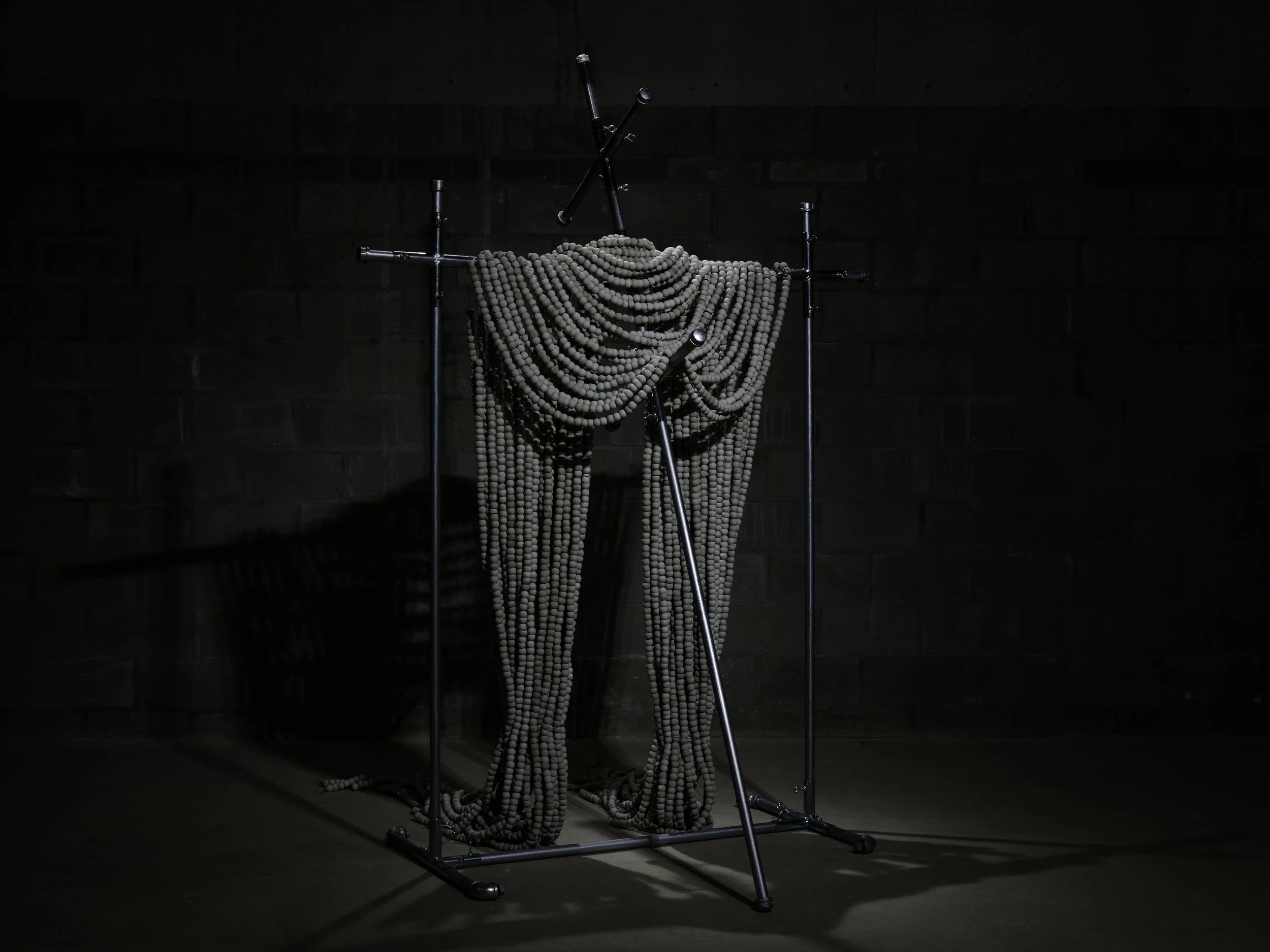
Before our interview, Luna Palazzolo-Daboul sent me a box of cement beads. Made in exhaustive repetition, they vary in color and texture nonetheless: dusty gray, almost black, shiny-soft, uncomfortably rough. I am moved by how light they are. Palazzolo-Daboul’s practice involves materials that require a particular endurance in order to wield, and they are selected both for their demands and their accessibility. Her beads, poured one by one, are strung onto wires and dangled from hanging rings, encircled into hearts, or draped across seven feet of upright galvanized piping. Bricks are formed into womb-like circles or tomb-like shards that are adorned with swans or stained glass. Utilizing the tools and mechanisms of labor, Palazzolo-Daboul upends the concept by enduring it on her own terms, which is a process she often writes about (she describes herself, incorrectly, as a bad poet).
Repetition becomes devotion as a sacramental choice deliberately removed from the systems that typically enforce it. It’s telling that Palazzolo-Daboul can’t deal, she says, “with the touch of cement”; even autonomous dedication can be torturous. The unexpected warmth of her work is found in revelations of both discomfort and peace: a hunk of unsmoothed concrete; the ecclesiastical quiet necessitated by a room of towering metal entities; the stunning sensuality of five feet of beaded cement hung over a galvanized spike and pooling at your feet.
Monica Uszerowicz
I often like to ask about an artist’s earliest memories of artmaking. Your approach to materiality is so singular.
Luna Palazzolo-Daboul
In kindergarten, we had an assignment to make a self-portrait with tempera on industrial, brown paper. That’s the first official work I made; it’s also the first work that made my parents want to send me to therapy. I saw myself as a monster, so it was an ugly face. My parents, who were in the fashion industry, were able to appreciate it, but were also a little bit scared of the awareness that I had. In a way, it has shaped a lot of who I am and the work that I do.
MU
How did you start working with heavier materials?
LPD
Growing up, I always made other things, and I did photography and worked in the fashion industry making window displays for luxury brands. I think that my natural tendency to gravitate toward the unorthodox kept me away from more conventional disciplines. I did a lot of mixed media, which involved readymade materials. Accessibility was extremely important to me because there’s an underlying relationship with capitalism, construction, and destruction. During Covid, I only had a hardware store available to me, two blocks away. Cement was similar to clay or ceramic, but it didn’t require a kiln. It made sense given how attracted I am to construction, to brutalism, to the decadence of materials that appear so simple. I later realized that this is a material that is in constant relationship to labor. I’m attracted to the found object, to the contradiction that it has with material, and how it can be heavy with memory, purpose, function.
Luna Palazzolo-Daboul, y nos comunicamos por el mismo muro que nos separa, 2026, concrete, custom aluminum hardware, wire, 98 × 38 × 32 inches. Photo by Oriol Tarridas. Courtesy of Luna Palazzolo-Daboul and Primary.
MU
Can you say more about your ongoing research on domestic and factory labor? In an essay for Fantasy Life, your 2025 exhibition at Rice Hotel, you wrote, “I labor and I devote on my own terms.”
LPD
I feel that labor and devotion are extremely close to one another, at least in my practice; yet I don’t think that they are interchangeable. Labor can be imposed onto someone, and devotion requires some form of consent. When I say, “I labor and devote on my own terms,” I’m thinking about my decision to submit myself to an extremely repetitive and physically demanding process. And I still try to retain some authorship over what the labor means to me. I’m interested in discipline, but I’m also suspicious of it because the systems that demand it from us are usually authoritarian: religion, gender, work, family, the art world. Everything that requires discipline from us feels authoritarian to me. When I make so many beads and put myself into a mechanical sort of functioning, I am referencing factory labor. When I’m weaving, I am mimicking domestic labor, but I’m establishing those conditions and the purpose. Repeating the same action is almost like reclaiming my attention. It’s something that belongs to me. The process may be punishing, but it’s not punishment.
MU
Domestic labor often goes unseen; in your work, we can truly see your hands.
LPD
I approach everything that I make in repetition with the same emotional and mental state. I try to remove myself from it. Simone Weil calls it “decreation”: the act of removing one’s identity to perform repetition. It’s the same formula used for prayer, meditation, punishment, torture. But even though I try to make the same object over and over, they are all autonomous. There are forty thousand concrete beads in the room, and although they came from the same mold, they’re never going to be exactly the same.
Luna Palazzolo-Daboul, this violent principle in a violent way, 2026, concrete, galvanized pipe, wire, 66 × 114 × 36 inches; background: A painting to hammer a nail in (paraphrasing), 2026, concrete, hot dipped galvanized spike, wire, 67 × 25 × 25 inches. Photo by Oriol Tarridas. Courtesy of Luna Palazzolo-Daboul and Primary.
MU
You’ve talked about these breaks as ruptures or moments of disobedience. Even your first self-portrait might be one of those moments.
LPD
That’s a beautiful point; it makes a lot of sense. I’m interested in how we put emotions and feelings into objects. Systems, units, and structures create expectations that I couldn’t fulfill for myself, or society, or my family. I like to see a system’s logic and make a small interruption. It feels meaningful. I think that tenderness operates in those interruptions, which is when a flower appears in my work or when it’s placed on an industrial carpet, like Safety Net (2025) was. I see the act of placing the work on a warm surface as a form of tenderness and therefore an act of disobedience. That it’s juxtaposed to something with so much hardness makes the gesture more vulnerable or strange. When a system is fulfilled or complete, it becomes resolved. I don’t think there’s anything worse than a resolved authoritarian system.
MU
Some of your new pieces remind me of bodies. That’s my own tendency toward pareidolia speaking.
LPD
That’s so interesting because I’ve always gravitated toward abstract objects on purpose. I like to maintain ambiguity. But this is extremely bodily work. There is a negotiation between my body and the materials, constantly. There’s only so much that I can decide about them because they’re dragged by the force of gravity. So I wouldn’t necessarily deny the existence of the body in it. The way that they fall makes a weight—like the Virgin Mary carrying Jesus. Carrying the work felt very much like carrying a body.
MU
Is there something meditative about making this work? Maybe it’s not meditative at all?
LPD
Absolutely. I treat this as if I was praying, meditating, or performing an act of self-punishment. Sometimes I don’t want to do it, and this is where it becomes performative. It’s forcing yourself to be in a mental place that you’re not always ready for. I don’t necessarily believe there’s an audience for that, but there’s a lot of it that I compare to an endurance performance.
Installation view of Luna Palazzolo-Daboul: Of Ivory and Flesh, 2026. Primary, Miami, Florida. Photo by Oriol Tarridas. Courtesy of Luna Palazzolo-Daboul and Primary.
MU
Does your new work represent a continuation of what you’ve been thinking about? Does it diverge?
LPD
A little bit of both. Repetition is something that has come up in my work before, and last year I started to work on what I call objects of devotion, which are smaller sculptures and smaller beads. This was a lot about the experimentation of the language and how Catholic systems appear in my work. I’m not using a found object anymore, and I’m creating these structures myself so that there is an element of authorship I can have in the design. And there’s also the scale, which means that the process is different, along with the investment it takes. But there’s an idea of devotion that always exists in relation to religion.
MU
I wanted to ask about that.
LPD
I don’t necessarily see the visual language as an expression of faith or religion. I’m interested in emotional structures and devotion, ritual, sacrifice, guilt, the ornament, bodily suffering, transcendence. With the beads, for example, I don’t think the meaning resides in one or two beads, but in the accumulation, the repetition, the duration. When the beads form a heart, the concrete remains industrial and heavy, but it also becomes vulnerable. I don’t think there’s anything soft or innocent about it. I think it can be involving of obligation, and sacrifice, and violence. I was raised as a Catholic, and I’m from an extremely conservative country. My relationship with Catholicism is, in part, aesthetic and cultural, but it’s also very critical. I like to borrow the language and the structure and maybe ask myself what happens when devotion is separated from obedience. When the rupture appears, that’s an act of disobedience for me. When the industrial or mental labor becomes feminine, that’s an act of disobedience for me.
Luna Palazzolo-Daboul: Of Ivory and Flesh is on view at Primary in Miami until October 31.
Monica Uszerowicz is a writer born and based in New York City.


