
Words by Erin Parish
At Primary in Miami’s Little River, the cool gray of the gallery sits in contrast with the midday sun and settles the exhibition into a steady tone that complements the works throughout. As a place without visual busyness, it is currently quietly punctuated by sculptures from the humblest of materials: ceramic. These are 2026 works by Wade Tullier. They establish a presence that feels measured and contained, with a subdued sense of joy.
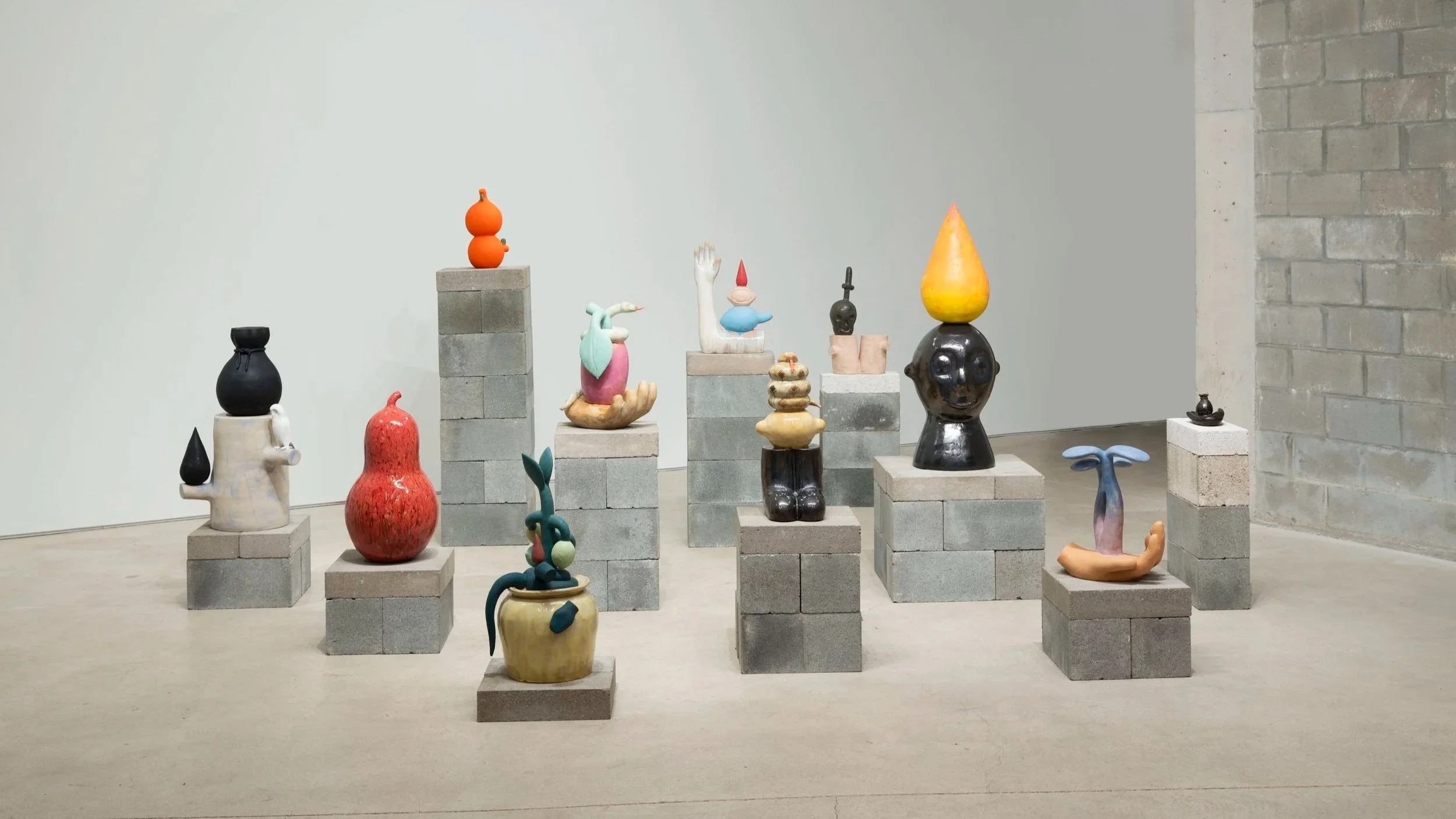
The exhibition contains a fat totem, two petite wall pieces and a population of tabletop-sized sculptures. The latter sit atop cinderblock pedestals of varying height. This extends and aligns the architecture seamlessly into the installation, a purposeful counterpoint.
Tullier titled his show un-evocatively: “Sky, Sea, Fruit, Hand, Seed.” This contrasts with the popular trend toward philosophically or sociologically complex exhibition titles. This probably stems from Damien Hirst’s infamous “The Physical Impossibility of Death in the Mind of Someone Living,” a.k.a. that shark sculpture. There can be an attempt to assign content through the title when it is absent in the works themselves.
However, Tullier describes: “I make sculptures that depict animals, figures, phenomena, and everyday objects. They are always recognizable but become elusive as I continue to reinterpret each piece. In this way, my sculptures act as characters in oral history: they transform as they are retold. While these objects remain familiar and are easily identifiable, the combinations of works remain ambiguous. They echo the layered, nonlinear structure of memory as it is excavated through storytelling.”
An eight-foot-tall totem of stacked fruit anchors the room: from the floor up, a blue hand holds a lemon, an orange and an oversized blueberry topped with an intense red apple. The leaves and fruit stems protrude to set up a rhythmic counterpoint. The scale brings a sense of familiarity into a different register. The configuration could be seen as a recollection of an odd American roadside attraction seen on a cross-country road trip. Without self-conscious “artistry,” its form echoes self-taught art, often appreciated for its revelations and connection to the spirit world.
Positioned to the left behind the fruit, a single white owl rests on a branch segment. The placement carries a precise sense of balance across the width of the room. It punctuates the spread of cinderblocks while maintaining its own space. Here, less is more and we are nudged not to be too serious. However, within this context, more is revealed and it won’t be all fun and games.
Tullier states, “The imagery in my ceramics traces back to the stories I heard as a child growing up in southern Louisiana. The objects I create pull from this history of natural disasters and human-made catastrophes, chance encounters with wildlife, and occasionally my unsettling experience as a forensic sculptor and researcher. My work responds to the natural world in an effort of balancing pleasure with pain and danger with awe.”
A forensic sculptor is a specialist who reconstructs human faces onto unidentified skulls using clay and anthropological data to assist law enforcement in identifying human remains. A combination of science and art, the work adds another layer to the skill on display.
Snakes, hands, birds and vessels repeat in different configurations. The color blocks are simple and imply a child’s creation, yet they are referentially sophisticated. Hands appear in multiple works: holding a palm tree, cupping a small vessel, supporting a red pot with an emerging snake and sad plants — a Garden of Eden reference. Elsewhere, a cross sits atop a Día de los Muertos-like skull on a tree stump.
The snake reappears in “Snake with Lemon and Boots.” This time it is coiled atop black boots and a lemon. As one stands in front of this sculpture and looks down, there is a moment of amusement when one’s shoes echo the boots in the sculpture. You are looking at it. It is looking at you. Each piece contains a soul and the inherent contradictions within.
The stylization of the imagery is like that of milagros charms of Mexico. These are small devotional metal charms used across Latin America to symbolize prayers, gratitude or hopes. Traditionally, they are pinned to saints’ statues or altars as offerings for answered prayers or to ask for healing. These elements circulate and return with slight variation.
The glazing seems casual at first. However, it alternates not only in color but also in a specificity of finishes that reiterates each object’s presence in space and in relation to illumination. Surfaces alternate between matte and glossy, catching light. Above the grouping, the gallery lights are arranged like those for a Broadway stage. Color remains restrained, held in blocks with minimal internal variation. The tones stay slightly dulled, allowing each form to maintain its clarity without competing for attention.
Tullier received a BFA from Louisiana State University and an MFA from Cranbrook Academy of Art. His work has been shown nationally and internationally, with recent exhibitions in Miami, Chicago and Detroit.
Across the exhibition, the work builds through a consistency of weight and presence. Forms repeat, relationships remain active. Narrative stays embedded within the material, carried through scale and the placement of symbols. These works use plain speak, and the objects feel as though they could be found on a home altar containing fancy dress dolls, Saint Michael and a series of water-filled glasses.
ARTBURST


