
Typoe Gran: World-building across drawing, sculpture, and public art.
by Alexandra Martinez
When Typoe Gran was five years old, he climbed Donald Lee Seiler’s Reclining Woman at Dante Fascell Park in South Miami, a public sculpture lovingly referred to as the Naked Lady. He slid down its leg, played on and around it, and came away with a question that would shape his practice: Why wasn’t the rest of the world built like this—open to touch and wonder?
Years later, after graffiti, recovery, and a devastating hand injury, Typoe arrived at Eden (2025), a sprawling colored-pencil work that took more than one thousand hours to complete. The piece turns a playground into a social world with a lifespan of its own: first animated by families and children, then overtaken by transgression and the slow creep of neglect. In Typoe’s telling, it becomes a cemetery of feeling by tracing what is lost when spaces of collective care succumb to alienation and decay.
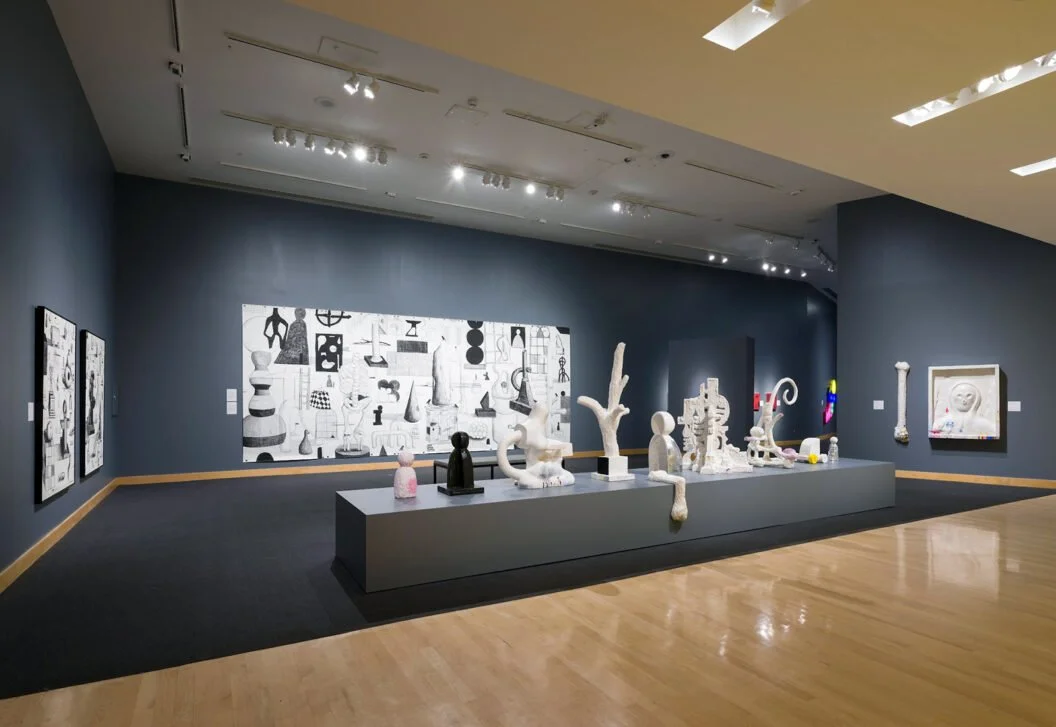
That dialectic runs through Anatomy of a Practice, the artist’s first solo museum exhibition, at the Boca Raton Museum of Art. Across monumental charcoal drawings, hand-built sculptures, and studio sketches, Typoe stages a world of structured anarchy, where joy arrives inseparable from dread. The result is a body of work that feels like an inner cartography of contemporary life that charts the strange condition of mourning the future even as we are still living toward it.
Alexandra Martinez: You come from street art and graffiti. How does that inform your current practice?
Typoe Gran: I think it’s the energy. When somebody is vandalizing something, there’s a wild freedom. That’s all this is: me responding to the space. There’s nothing planned. I’m building a world in my head, and I’m letting it become what it wants to become. Sometimes that’s much more poetic than when I try to plan a piece of art. Once there’s movement, it just flows. Graffiti also makes its way into the sculptures. One of the things it denotes is time. There’s something about seeing layers that references time. And then also youth. We can only be young once. To be young and stupid is something I sometimes look back on and smile at, but that’s also where I learned how to grow up.
Typoe Gran, The Eleventh Hour, 2025, charcoal on paper, 72.5 × 55 inches. Courtesy of the artist and Primary.
AM: Your work feels both deeply personal and widely symbolic. How did you arrive at this vocabulary?
TG: It’s all part of the human experience of learning and building. A lot of it references love, death, and religion, which are the different things that are innate in humanity and how we build the world. When I first started working with blocks and early childhood ideas, it was in response to a moment when everybody started getting really divided. I began asking myself: Why are we like this? Why are people so mean to people they don’t even know? Nobody’s made like that. We’re taught. So I started thinking about childhood education, family structure, and how children are shaped by the people around them. I was trying to understand the world we are currently living in so I could figure out where the hell we go from here.
AM: Your work oscillates between joy and something more ominous involving a reminder of death and destruction. How do you interpret that shift?
TG: I think life is light and dark. I only know happiness because I know what pain is. I’ve had a lot of both in my life, and when you go through things that are really dark, everything else just seems brighter.
AM: In Eden, there are lots of little details: the graffiti, the tombstone. There’s decay even though it looks like a utopian rainbow. How intentional are you being?
TG: A lot of it’s intuitive. I had an idea of a lost park that was just at the beginning of decay. I actually want to do a follow-up to Eden that would be fifty or a hundred years later, where it’s just carcasses and complete destruction, and you can barely tell what it was. With The World as I Am (2025), I wanted to hold back with the color and focus on form. There’s something about the rawness of charcoal that gets straight to the point. Color can be a softer way in. I was telling people that the big piece was like pulling the mask off. If the colorful work is the Halloween mask, this is what’s underneath. Once I stripped the color out of the room, people started responding differently. During the opening, I had multiple people come up to me crying and telling me about loss in their lives.
AM: The works feel deeply emotional.
TGI just needed to respond and put this out. I had a crazy childhood. I had a lot of friends die. A lot of really intense things happened. So this is me sharing myself as I see the world and live in the world, and hoping that people would just feel this very human way of reaching out and that I wouldn’t even have to explain it.
AM: Color can be distracting, but the way you’re using it here, it feels like an underbelly. You can only appreciate the color because you’ve experienced the darkness.
TG: Exactly. I wanted some of the color in here to feel almost like a sunset: the day going down, the day coming up, a new day, a new life, a new chance to build again. I’ve been in recovery for twenty-two years, so a lot of my thought process is one day at a time. Just for today, I’m going to show up for myself. Just for today, I’m going to build the world I want to be in.
AM: You’ve been doing public work for so long, but these sculptures are innately different because they’re not perfectly manufactured. How was your process different with these?
TG: I hurt my hands years ago doing martial arts, which is how I really got into manufacturing and making public art. I cracked and fractured all the bones in my hand, tore the ligaments connecting my arm to my hand, and had nerve damage, so I couldn’t use my hands for five or six years. I would do a loose sketch, and then assistants and manufacturers would help me build. So now I appreciate the making of it and the materiality of it. The structure is foam. When I was growing up, my mom owned a party-decoration company and used to carve foam and build all these things. The bases are carved out of foam, which is freeing because it’s additive and subtractive. Then the layer on top is a paper clay mixed with cement, so it becomes solid and can last forever. These were made for this exhibition, and they were made from the drawings. Every morning, as a sort of meditative practice, I start putting pen to paper. I work out and then go straight into drawing, and this is what comes out.
AM: There’s a lot of discipline in your practice. Even the organic forms feel methodical.
TG: I love systems. I always think in grids because the whole world is built on grids: streets, neighborhoods, systems. Even when I was working out, I made grids on the floor and realized my body fit perfectly within those squares. I used to only draw on graph paper. It was terrifying when I started drawing without it. If I looked at a blank page or canvas, I didn’t know how to respond without the guidelines.
AM: How did you get over that fear?
TG: Eden is actually the only thing in the show that has a penciled grid under it. That one is very structured world-building. The others are more chaotic. With those, I just have to make the first mark. My best advice to myself is to get the hell out of my own way and let the work come out. The more I sit back and think, the more I get caught up in fear and aesthetics. None of that is helpful. It has to be a response.
AM: It feels almost like a structured anarchy.
TG: Yeah, exactly. I like that. I have a structure that allows me to be more creative and free. Most people probably imagine I’m up all night partying and then making crazy things, but I get up super early, work out for two hours every day, go straight into the studio, and work for a certain number of hours. I have a very specific routine that then allows my mind to be open. There’s freedom in the structure.
AM: How does the meaning of your work shift across mural, public work, and museum space?
TG: Public work is different because I don’t want it to be so grim. There are children, families, people who may be having the worst day of their life. In that split second, what do I want to say to that person? I’d rather say: We could be anything, and we can build anything. If you’re coming into a museum, I can get more introspective. The darkness is still there in public work, but in public space I have a responsibility to be careful about how I’m putting that message into the world.
Installation view of Typoe Gran: Anatomy of a Practice, 2026. Boca Raton Museum of Art, Boca Raton, Florida. Courtesy of Boca Raton Museum of Art.
AM: This is your first solo museum show. How did you arrive at the title Anatomy of a Practice?
TG: When I started building the show, the museum team came into my studio and loved all my sketches and my routine, and they were like, We should show these. I’d never really let anyone see any of this stuff. So this is really a look into my practice and my inner practice. It was difficult to share that with everyone else because I’m so used to being private about everything. But it really was a breakdown of how I world-build. I also thought it was an appropriate double meaning because there is so much more literal anatomy coming into the work. It’s not just a block now. It’s bones and natural things.
Typoe Gran: Anatomy of a Practice is on view at the Boca Raton Museum of Art in Boca Raton, Florida, until October 11
LINK on BOMB.


