

AUTUMN CASEY will have three new works in the form of beach towels available at the PRIMITIVE LANGUAGES table in the Zine section of the LA ART BOOK FAIR. The works are pulled from her latest body of work “Balancing Infinity, While Hanging Upside Down. Watching Lovers Fall from Grace Underneath the Ground.” Each piece comes complete with your very own box of Star Crunch. Delicious in every way.


Vice on Autumn Casey
Words by Monica Uszerowicz
The experience of entering a three-dimensional tarot deck is akin to viewing Autumn Casey’s solo exhibition at Primary Projects, both in its meditative quality and the title alone, Balancing Infinity, While Hanging Upside Down. Watching Lovers Fall from Grace, Underneath the Ground. There’s a piece that refers to the show’s name, too: a Ferris wheel cart strung upside down with stuffed gloves and Mickey Mouse hands dangling, their arms once blithely in the air. Below are two bears in a state of tantric ecstasy: a plush blue Care Bear’s face is straddled by a pink bear-shaped candle, that’s quite literally melted into its partner. One might infer from them the tarot’s Major Arcana, the Lovers. The Ferris wheel cart is the Hanged Man: the ultimate symbol of transformation, even rebirth.
The show’s name comes from a poem Casey wrote after a three-card reading, which became a daily ritual. She’d pulled the Lovers, reversed, along with the Two of Pentacles and the Hanged Man. “I asked the cards, ‘How do I describe you?’” she explains to The Creators Project. “I felt like I was the Hanged Man—and when I was able to create again, it was like an explosion. Sometimes people think spiritual growth happens in very serious moments, so this is about that reconciliation—and just like the tarot cards, there’s an underlying subtle darkness. There is positive and negative. It is always about balance.”
The language of the tarot is first about the initiations of life—the way we move through it, transforming—and then about balance: the alchemical space between two ideologies. Casey’s art practice is like that, too, her sculptures often massive but hanging precariously, her video work tenderly exploring history and memory. Balancing Infinityfeatures a series of sculptures and 78 collages—functioning, effectively, as a tarot deck of their own—all inspired by the Rider-Waite deck.
The collages, constructed over the last three and a half years, contain, as Casey describes, “everything from old art history books […] to illustrated Shakespeare plays.” Like the unfolding of a reading, the first set of collages seemed to make themselves. “I would pull images and then infer which card it was, seeing which archetypes drove the collage,” she says. Casey’s Hermit card features a woman lighting her way through darkness, a man spinning a gradient of bright stripes, and a sleeping figure; her Three of Swords—depicted in the Rider-Waite as a heart pierced by three blades—has a bemused Charlie Brown, Snoopy atop his head. Sometimes, the pain inferred by the Three of Swords is confusing.
“The same idea fell over into the sculptures; I let them build themselves,” Casey explains. While the collages line two walls, the sculptures are spread out, creating an indoor garden of strange, delicately assembled symbols and found objects—pieces of Casey’s childhood, toys and treasures and furniture. The Fool sculpture is a frolicking wire man, clothed in a shirt sewn by Casey’s grandmother for Alice in Wonderland’s white rabbit. Judgment, Light as a Feather, a reference to the card and the Egyptian goddess Maat’s weighing of the heart, is a foam cross sprouting tiny yellow flowers, little toy growths.
On a recent visit to the space, Casey gestured to one sculpture, all flower-adorned blue yarn flowing from the curved legs of a table. “Do you want to take a guess as to which this one is?” she asked. “The Empress?” I replied. I was wrong: it was the Queen of Cups. In the Rider-Waite, she stares at her chalice, soft water pooling round her feet. Later, Casey gave her a more humanoid shape, though she’s still lush and sky-colored.
To be clear, Casey’s sculptural references to the tarot are not so specific nor immediately obvious, and her collaged cards have a life of their own. Tarot is often about the strength of the self, and so too is Balancing Infinity. To evoke the cards is really to evoke the archetypes of daily existence, the kind we experience in our own emotional landscapes—when we play the fool or or feel reborn—and, at least in the realm of an art space, we can understand these moments as we’d like. Balancing Infinity, then, is about our own interpretative power. It can mean (almost) whatever you want it to.

New Times on Autumn Casey
Words by Ciara Lavelle
At the opening of Save Your Selves, the group’s intricately stacked pile of personal detritus, found objects, lights, and video displays keeps blowing a fuse. As the lights dim, artist David Anasagasti, better known as Ahol Sniffs Glue, hurries outside to the fuse box and returns with a stepladder. Grinning humbly, he shuffles along the wall of Locust Projects while squeezing past viewers — the work reaches 15 feet tall and consumes nearly the entire room — and opens the ladder so his collaborators, artists Jason Handelsman and Jacob Katel, AKA the President and Swampdog, respectively, can reset the screens on top.
Even with the lights out, there’s plenty to keep gallery guests entertained. They lean forward to peer at empty Kool cigarette boxes and years-old ticket stubs. They point excitedly at familiar relics such as a toddler-size Dolphins jersey and a coaster from Mac’s Club Deuce. They marvel at the ATM, laid on its side to display one of Ahol’s characteristic eyeball designs; at a bottle of Evian filled to the brim with cigarette butts; at Bill Cosby’s 1966 album Wonderfulness on vinyl. They become transfixed watching raw footage of the “butthole tattoo girl,” a video that went viral after Swampdog shot it for New Times Broward-Palm Beachin 2012. They step back to take in the entire mountain of immaculately stacked rubble in its grimy glory. Then they dive in again.
Found-object art is nothing new in the art world. Design Miami lists the trend among its top themes this year, with galleries from Chile, London, and New York showing works incorporating reclaimed items. Last month, artist Bhakti Baxter launched “First Light,” which turned ocean detritus into quirky character sculptures. But during Art Basel, a time when local galleries and museums usually present the work of artists from outside the city, Miami-made found-object art does more than turn trash into treasure. It forces viewers from across the globe to confront a real piece of the city, not just the pretty face it puts on for one week each December.
Around the corner at Primary Projects, artist Autumn Casey achieves the same goal by vastly different means. Her exhibit, “Balancing Infinity, While Hanging Upside Down. Watching Lovers Fall From Grace, Underneath the Ground,” combines a collection of 78 collages, each based on a different card in the tarot deck, with pieces of sculpture crafted from personal mementos and found objects. The collages, thoughtfully crafted by the nomadic artist over three years, use pages from sources including art history books, illustrated Shakespeare plays, children’s dictionaries, personal drawings, photos, and other scraps the artist discovered “out in the world.”
If Save Your Selves reflects the gritty work of its three creators, “Balancing Infinity” reflects Casey’s thoughtful, spiritual worldview. The materials used here — a rickety wooden carnival ride seat dating back decades, for instance, or an heirloom sewing machine that once belonged to Casey’s mother, now cut in half — don’t merely conjure memories. To Casey, the objects have a destiny, and it’s up to her to help them realize it.
“I incorporate personal objects into my work because it feels like the natural thing to do,” Casey explains. “I start to view everything’s potentiality as a material or starting point. It’s like everything is always marinating until it’s clear to me that the objects are ready to speak.”
Huffer’s collection speaks too, mainly through juxtaposition. Look closely and you’ll notice how religious votive candles and fortune cookie papers form a superstitious tableau. Or check out the nuanced way a pile of gold-wrapped condoms sits behind that Cosby album. Handelsman calls the connections between the items “constellations of alignment.”
“These are things we’ve been gathering all our lives. We all have our own curatorial type of eyes to things that get our attention, things that have made it through many different moves and many different situations,” Handelsman explains. “It’s been an ongoing collection of stuff, but it just so happens to be the right time for the concept, for us to tell our own story, and make sure it’s told correctly.”
Though both Save Your Selves and “Balancing Infinity” incorporate gems from Miami’s dumpsters and street corners, they present vastly different reflections of the city where they’ll be shown. Huffer’s pyramid is frenetic and visceral; there’s real blood on the thing. Casey’s work is more cerebral and sparser, letting the essence of each piece shine individually. It’s part of a “constant regeneration process,” she says, in which items with great personal meaning to her cross over to a sort of art-world afterlife when they’re sold.
“I let something go, but then in a way it becomes immortalized,” she says, “and then given the chance for more people to relate to it.”
Unsurprisingly, Casey isn’t much for material things. She keeps her collection of personal tokens and found detritus in storage, waiting for the right time and project for each one to reveal itself. For “Balancing Infinity,” she collected materials from the streets of Buena Vista and Little Haiti, bridging the otherwise vast expanse between the residents of those areas and the typical Design District shopper.
“The physical location of the gallery is right in a line of lots of high-end, luxury retail stores. I make my way to the gallery from the other side of the neighborhood. I’ve found a lot of materials that have been incorporated into the sculptures… and they reflect the community immediately surrounding the area,” she says. “Like a bridge where the two neighborhoods meet. And again like finding a balance between the two.”
The irony of showing cast-off items from Miami streets in one of the city’s most expensive retail centers isn’t lost on Casey either.
“I hope that my exhibition will be a breath of fresh air for Basel-goers,” she says, “and that the use of humbler materials might help one reflect more on their own humility.”

Lone Palm on Autumn Casey
Words by Joanne Davila
Autumn Casey is a sculpture and performance artist who this week debuts her second solo exhibition at Primary in the Design District. The deeply personal exhibit showcases a set of sculptural installation works, and seventy-eight 2-D collaged tarot cards inspired by the Rider-Waite-Smith tarot deck. The deck was given to her at age 18, at a Christmas party. During a particularly tumultuous and untethered period of her life, she learned how to read the cards and began to give herself readings everyday. Gradually, experience led to Casey’s own creation of a full deck of tarot cards – a culmination of three years of work. The resulting pieces are all assembled with found objects or items given to the artist by friends or family.
“I have an arsenal of objects around and people often give me things,” says Casey. At a visit to the show Casey points to items around the gallery – a resin statue of a horse, pieces of marble, two worn Care bears – all bestowed upon her. “I love things that look lived, that have a sense of history.”
Casey’s use of collage and assemblage is a theme that has been present throughout her previous work – she often deploys existing materials in unexpected, idiosyncratic ways. In this case, the tarot deck served as vehicle for both self-reflection and her art practice.
“Sculpture is what comes most natural to me, and at the time I had no space for sculpture, so I started to make these collages,” says Casey.
Drawn to the simplicity of the illustrations, the resulting collages are a blend of her inner narrative from that period of time and her understanding of the cards. “Certain cards infer certain meditations. There is the idea that they depict archetypes of how people are. So it’s like looking into a mirror.”
Casey’s deck is collaged from art history books, magazines, home décor journals, pages of illustrated Shakespeare, found images and some hand drawings. The first pieces came together without any organization and as time wore on, she began to accumulate a library of sorts, cataloging items she saw for use in future collages.
The Rider-Waite-Smith deck was originally published by the Rider Company in 1910. Its images were drawn by illustrator Pamela Colman Smith from the instructions of academic and mystic A. E. Waite. It is widely considered one of the most popular tarot decks used in the English-speaking world and well known for it’s simple imagery and abundant symbolism.
Casey’s interpretation of the symbolism connects history with the future and makes it her own. There are past pop culture references – Whitney Houston and Marilyn Monroe – appearances from familiar historical paintings and imagery that feels in sync with the current feminist movement. But though the cards carry concrete imagery, they shift in meaning depending on their relationship to other images, and to the viewer. “Tarot teaches you a way of how to understand the world,” Casey says.
For her the practice taught her about working to attain a balance in life. For now, “My approach is to be as natural and honest as possible.”
When she finished her collaged deck, she pulled three cards: Two of Pentacles, the Hanged Man, and Lovers Reversed. Reflecting upon these three, she wrote a few lines:
Balancing Infinity
While Hanging Upside Down
Watching Lovers Fall from Grace
Underneath the Ground.
The artist, who has had her moment at Art Basel before – in 2012 a piece titled Cicada involved her screaming at the top of her lungs during Basel events – will also perform with her all-girl band, Snakehole at Churchill’s on December 1st. Their new album comes out next year on Wharf Cat Records.
Her work has been shown and collected by the the Perez Art Museum Miami and the Museum of Contemporary Art, North Miami, where she won the 2010 Optic Nerve XII. She currently lives and works in Philadelphia and Miami, where she is represented by PRIMARY.

Modern Luxury on Autumn Casey
Words by By Anetta Nowosielska
Using cards normally associated with mystery and mysticism, Miami artist Autumn Casey reveals her rawest and most personal emotions. Elysian Fields could easily be Autumn Casey’s artistic opus. The visual narrative, now included in the permanent collection of the Pérez Art Museum Miami, offers an emotional peek at the connection between the artist’s Alzheimer’s-ridden grandmother and the music of her youth. The video movingly portrays how the former showgirl is magically transported out of the disease’s darkness into brief moments of clarity and bliss. “Frank Sinatra calms her down,” explains Casey. “I couldn’t be happier that my nana is immortalized in this piece for others to contemplate about life.”
Reflecting on life is a common theme for the Miami-raised conceptual artist, whose oeuvre includes collage, sculpture and video. Casey’s ability to tap into larger consciousness has already won her some impressive accolades. She was awarded the top prize at Optic Nerve XII, the Museum of Contemporary Art North Miami’s annual short video contest, for a film titled “Getting Rid of All My Shoes”, in which Casey seemingly sheds layers of herself by removing the frivolity of superfluous objects.
Similarly, her tarot card collection, which is a major component of a new solo exhibition at Primary Projects titled “Balancing Infinity, While Hanging Upside Down. Watching Lovers Fall From Grace, Underneath the Ground”, masterfully plays with our collective zeitgeist. The assemblage spans three years of deeply personal work that translates private mundane moments into shared revelations.
“Each piece means something to me,” says Casey, “and even though I have gone back to tweak some pieces that needed extra work, these are very true to what was happening in my life and are now connecting me to something entirely different.”
These are the kinds of emotive experiences Primary Projects co-founder Books Bischof is betting on. “It’s rare to represent an artist who can evoke so much emotion in people,” he explains. “We exhibited Autumn’s work a couple of years ago, and that debut solo show, AGALMA, was a celebration of nostalgia built out of relics from her childhood, which included, among other things, items from her nana’s kitchen.” This time around, the artist will use the aforementioned tarot cards, sculptures and videos to focus on the power of reflection to overcome crushing life experiences. As Casey herself puts it: “I’m using objects I’ve lived with for years that I’ve converted into artifacts that tell a bigger story.” Art doesn’t get more introspective and personal than that.

CLRVYNT on Snakehole
Words by Zoe Camp
A word of caution: Don’t get on Snakehole’s bad side. Less a rock duo than a pair of Floridian Valkyries, Autumn Casey and KC Toimil are well-versed in the art of translating the ramblings of the reptile brain into warped, off the cuff (or rather, scream-of-consciousness) noise-rock, as they so powerfully demonstrated on last year’s debut 12″. Consider them Death From Above 1979’s fierce, feminist doppelgangers: two ferocious women dead-set on stirring up chaos.
It should come as no surprise, then, that Snakehole tapped Nina Hartmann —an adored, East Coast-based visual artist guided by similar unhinged principles — to craft the video for “Something to Become,” taken from the aforementioned self-titled release. Like Casey and Toimil, she weaponizes her art against status quo in all its forms — aesthetic, political, sexual — unleashing a shared confrontational energy that informs the basis for the video’s debauched, lo-fi spectacle. Gritty, surreal acts of violence abound, as we watch Snakehole torch a swan (calm down, animal lovers; it’s an effigy), stab a wall and, of course, rage (in a yard full of burning garbage, natch). To brighten the mood Hartmann throws in numerous shots of an adorable stuffed animal who, ostensibly, has viewed the (miraculously) victimless bacchanal through soulless, beaded eyes.
Watch below, and please, kids, don’t try this at home.
Typoe at Faena, Buenos Aires
Wanted to congratulate our partner here at Primary, Typoe Gran, on his upcoming solo exhibition at Faena Art in Buenos Aires, Argentina. Excited to see the original sketches come to life. Here is more information about the exhibit if you are in the neighborhood. Enjoy.
Faena Art, the international nonprofit organization that supports and produces multi-disciplinary and time-based experiences, announces the commission of an immersive and participatory installation by Miami-based artist Typoe. The work, titled Forms from Life, will be presented at Faena Art Center Buenos Aires from July 20 through 31st.
When Faena Art Center hosts Typoe’s first exhibition in Latin America later this July, Sala Molinos will be transformed into a surrealist world of labyrinths and fantasy. Comprised of blocks and towers, Forms from Life brings to mind the both ancient Rome as well as the Art Deco facades of Miami, the artist’s hometown.
Typoe’s latest creation explores basic geometry, order and beauty of the physical world and reimagines basic building blocks of tropical colors and classic faux-marble that tease the imagination and invite visitors to construct new worlds for their wildest dreams, generating new experiences of communal creation and social interaction. At the same time, by conjuring up ruins and losses of deferred dreams, this work becomes a contemporary memento mori that elicits the inevitable passage of time and a personal journey through youth and beyond.
Forms from Life draws upon Typoe’s previous commission for the Faena Art Elevate series—a program of rotating site-specific commissions installed in the elevator of Casa Claridge’s in Faena District Miami Beach. For Elevate, Typoe created a playful and experiential work titled Getting Up that encouraged viewer participation and recalled the childhood pastime of playing with letter-shaped magnets; ultimately serving as a transgressive act of auto-definition and a reclamation of public space for social interaction.

Boca on Kenton Parker
Words by John Thomason
The strongest compliment I can pay to Kenton Parker’s exhibition at the Art and Culture Center of Hollywood is that I forgot, if only for a few fleeting moments, that I was standing in an art museum. Parker specializes in walkable human-sized structures—experiential art projects that invite visitors inside. In spite of their self-reflexive flourishes, they transport museumgoers to other places—of warmth, of regret, of teenage community—far removed from the often-academic sterility of a gallery space.
The centerpiece of the exhibition, in terms of its visual, aural and tactile significance, is “My First Kiss,” an intimate treehouse with room for three or four temporary residents at a time. It comes across as a place of escape and refuge, fortified on all sides by planks of wood, giant fronds and foliage, suggesting an ideal hideaway for the exchange of furtive kisses, potent weed and off-key karaoke to the music your parents hate (some of it, from the likes of AC/DC and Nilsson, plays on a loop from somewhere in the structure). Inside, butterflies painted directly onto the wood walls complement chrysalides gestating in jars. And if you lay on your back, you can lose yourself in “Space,” a mesmerizing seven-minute video of the cosmos beaming from a flat-screen—a dash of the universal attained through an edifice that couldn’t be more personal.
If you never want to leave this enclave, that’s probably the point. Some visitors may long for treehouse experiences gone by, but the piece arguably works better for the treehouse-deprived majority, the city dwellers who never grew up with such structures, and who get to experience nostalgia by osmosis. “My First Kiss” feels like a lost memory newly recovered, even if it never existed to begin with.
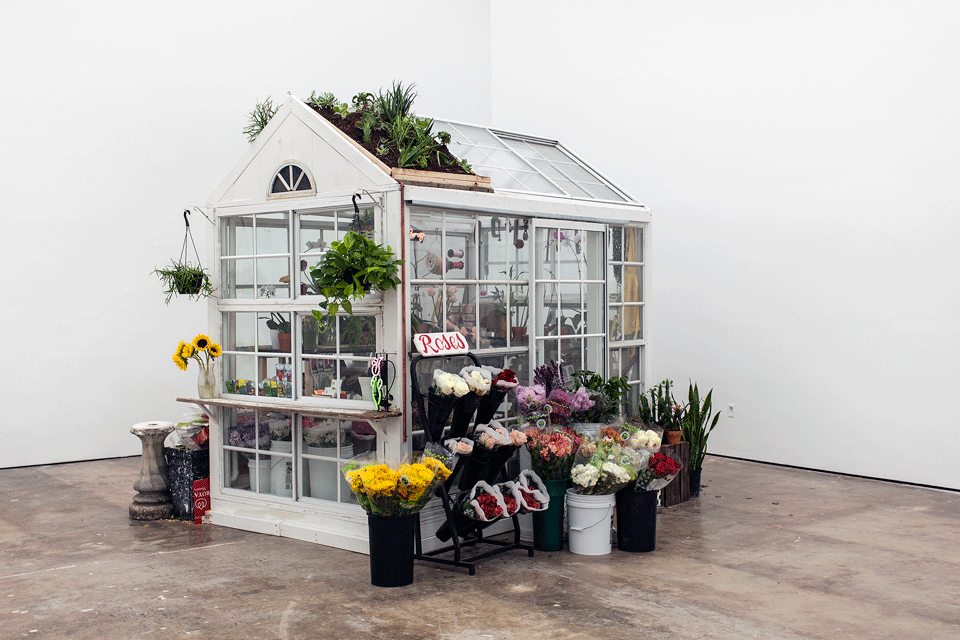
The treehouse shares the main gallery floor with “Always Sorry,” a mock flower shop whose canny name is a commentary on the boneheaded, inevitably male mistakes that keep florists in business. It’s even more lifelike than “My First Kiss,” because it’s a full 360-degree effort: Behind the shop, chipped pots and crates contain logs, tree branches and watering cans, and there’s a wheelbarrow and open bag of Miracle Gro scattered among the detritus, waiting for their next project.
At the front of the shop, live flowers imprint aromas in the air that will signify different emotions for different people. Cacti and aloe sprout from a rooftop mini garden, and the inside of the cramped store is littered with arrangements (fake ones this time), seed packets, spray bottles and the occasional gewgaw. I’ve never seen a flower shop like that outside of “The Little Shop of Horrors,” but perhaps that, too, is the point: “Always Sorry” is a hyperreal evocation of a theoretical business.
Works in acrylic, oil, graphite and crayon hang on the surrounding walls, offering mostly abstract imagery that harmonizes with the centerpieces thanks to vivid, childlike, explorative strokes. Existential profundity imbues the deceptively simple “Infinity Clock,” Parker’s refurbished wall clock with the hands removed, which reinforces the outside-of-time ambience of the show.
By contrast, the need to recognize and catalog the passing of time colors the deliberate banality of “Traffic,” an hour-long montage of Parker’s work commute in L.A., filmed with a mounted camera and scored with whatever music he was listening to on his car stereo at the time. I appreciate the artistic sentiment involved, but it doesn’t make “Traffic” any more exciting to watch—especially when the sights, smells, sounds and false memories of “My First Kiss” continue to beckon, just a few steps away.
“Kenton Parker: Everything Counts in Small Amounts” runs through Aug. 21 at Art and Culture Center of Hollywood, 1650 Harrison St., Hollywood. Tickets cost $7 for adults and $4 for students, seniors and children ages 17 or under. Call 954/921-3274 or visit artandculturecenter.org.
Sun Sentinel on Kenton Parker
Words by Phillip Valys
For Kenton Parker, love means having to say you’re sorry with 16 bouquets of fake flowers.
There they sit in potted plants – faux drooping tulips and full-bloom orchids – inside Parker’s flower stand, where the artist has woven romance and apologies to all the ex-girlfriends he’s ever loved and devastated. Titled “Always Sorry,” the freestanding installation, about the size of a broom closet, is planted in the center’s main gallery. The shop’s white-painted wooden frame is pockmarked with dents and chips, its windows stained with dirt. Kitschy ceramic cat statues top wooden milk crates. Trowels and hammers hang on the walls next to a used dog collar. A column of live cacti runs along the spine of the building’s roof.
For Parker, there’s zero ambiguity about the phony flowers: They represent doomed, superficial relationships. He blames himself for all of them.
“I would constantly be screwing up and giving women flowers, always being in the f—– doghouse,” Parker, 48, says. (He currently has a girlfriend.) “I have this ability to speak in long sentences, faster than my head and heart can keep up. I’ll be upset with someone and apologize to them in the same sentence, but most people can’t accept your apology that quickly. I mean, that’s not how people work.”
A wiry California native who likes to speak in rapid-fire sentences laced with expletives, Parker is busy this week installing the two centerpieces of his new solo show “Everything Counts in Small Amounts,” opening Friday, June 10. The flower shop, when finished, will be joined by another freestanding building: “My First Kiss,” a lyric little shack of a treehouse on raised cinder blocks. A sanctuary to teenage romance, Parker says the treehouse is just large enough for two people to crawl inside, lay supine and gaze up at the “stars,” shown on a video screening on a flat screen TV anchored to the ceiling.
“It’s a storybook treehouse. Kids or adults can come inside and draw on the walls,” says Parker, who bought live cocoons of monarch butterflies from Butterfly World in Coconut Creek, which will hatch inside the treehouse during the exhibition’s run.
The treehouse, which first debuted at Soho Beach House in Miami Beach during Art Basel 2014, wasn’t always a place for innocent adolescence. Visitors that year treated the space like a VIP champagne room, scrawling graffiti on the walls, having sex, smoking weed.
That’s how Parker prefers his life-size rooms to be used. An Army brat who bounced around from South Korea to San Diego to Fort Benny, Ga., as a teenager, Parker found stability as a nightclub promoter. During his twenties, he threw invite-only parties for San Diego’s nightlife elite, building decorations such as flying dragons and go-go dancing cages. Once, in the 1990s, he installed a fake taco stand in the center of a nightclub. Parker witnessed people ducking inside to snort cocaine.
Parker’s freestanding sculptures owe a debt to Robert Rauschenberg’s ready-mades, in which the pioneering artist took everyday objects and combined them into art.
“This is a kid-oriented show, but so much of my work is debaucherous,” Parker says of this exhibition. “These installations are 3D versions of my feelings. It’s a f—— journalistic diary of my life. I’m a very sensitive person, so my personal life is wrapped up in these places. The dog collar in the flower shop belongs to Lucky,” his boxer-ridgeback mix of 17 years, whom he says he had to euthanize the day before a recent art show opening.
Parker’s paintings and drawings, which are also autobiographical, will decorate the walls of the Hollywood center’s main gallery. Many are untitled, but include his mother’s quilt showing his family home next to the Sutter Buttes, a cluster of mountain-like peaks and knobs in Sacramento Valley, Calif. In other drawings, made with oil stick and crayon, Parker depicts California’s recent forest fires in abstract swirls and circles.
“There’s this living quality to all of the works, like an ongoing story,” says Books IIII Bischof, whose Miami Design District gallery, Primary Projects, represents Parker. “You see his heart in all of his works.”
In a separate gallery, Parker will draw paper greeting cards, and suspend them on clothesline for visitors to take home. Parker wants patrons to create their own greeting cards on paper, then crayon the room’s walls the same way they would the walls of his treehouse.

On View Talks with Kenton Parker
Kenton Parker’s work is about setting a stage for innocence, for steadfast friendship, for sharing and helping, for letting go and moving on. His tributes to friendship and first love take place in modestly scaled vernacular structures—a flower shop, a tree-house, a tool shed. In these structures, re-created in the gallery, Parker channels every child’s escapist fantasy of a hideaway, a special place in which they can dream, be themselves, invite their favorite friends, and be close to nature. The gentle life cycle of flowers and butterflies provides a mirror for the emotions and transitions of youth. For the familiar dramas of being close and then moving apart.


