• Artists
    • Dustin Emory
    • Typoe Gran
    • Jimena Losada Lacerna
    • Luna Palazzolo-Daboul
    • Piero Penizzotto
    • Paula Santomé
    • Philip Smith
    • Wade Tullier
  • Exhibitions
    • Now
    • Future
    • Archive
  • Public Art
  • Fairs
  • News
  • About
    • Who?
    • Architecture
  • Shop
  • Menu

Primary.

  • Artists
    • Dustin Emory
    • Typoe Gran
    • Jimena Losada Lacerna
    • Luna Palazzolo-Daboul
    • Piero Penizzotto
    • Paula Santomé
    • Philip Smith
    • Wade Tullier
  • Exhibitions
    • Now
    • Future
    • Archive
  • Public Art
  • Fairs
  • News
  • About
    • Who?
    • Architecture
  • Shop
BLOG_IMAGES_NEW_SITE_SIERRA.jpg

Autumn Casey at La Sierra

August 06, 2017

Excited to announce Autumn Casey recently started her month long residency at La Sierra.

La Sierra Artist Residency brings art and nature together to inspire new works of art and to generate dynamic ideas around its core values of creativity, sustainabilty, cultural exchange and wellness. By supporting the work of artists, writers, designers and thought leaders in these areas, La Sierra Artist Residency dedicates itself to changing lives in Colombia and beyond. La Sierra programming includes an artist residency, educational initiatives, projects in partnership with international cultural organizations, and more. From its base on the Caribbean coast of Colombia, La Sierra Artist Residency is a nexus for cultural production and activities in Latin America, the Caribbean and the United States.

La Sierra Artist Residency is intended to support artists working professionally in all mediums, including painting, drawing, photography, film, sculpture, performance installation, architecture, industrial design, permaculture, music and writing. Artists are encouraged to create new work inspired by their experiences here or continued from their existing studio practice.

La Sierra Artist Residency is an opportunity for emerging and established creative professionals from all over the world to link their inspiration and creativity with the raw, natural environment that surrounds us all. This Artist in Residency program will provide the opportunity to cultivate creativity while seeking solitude, connecting with nature and facilitating a cultural exchange on the Caribbean Coast of Colombia.

La Sierra takes its name from its unique location on the Caribbean Sea in the foothills of the Sierra Nevada de Santa Marta in northern Colombia, South America. Here you will find the highest coastal mountain range in the world, with peaks of  5,700 mts (18,700 ft) above sea level only 42km away from the sea. This drastic change in elevation cultivates a variety of ecosystems in direct proximity of each other, harboring an incredible amount of diversity in flora, fauna and culture. In fact, every single ecosystem that exists on earth thrives in the Sierra Nevada mountains. Hence why the native people refer to this area as “The Heart of the World.”

Surrounded by jungle, mountains and virgin beaches, artists are welcomed to create, study and explore. We provide accommodation for one month, allowing the artist in residence to leave behind routine stress and focus on their immersion and connection to the land. The intention for this time is to slow down, reconnect with the rhythms of the earth and awaken the depths within.

More About Autumn Casey

Autumn Casey (b. 1987, Dallas) draws on a variety of personal relics and pop-cultural ephemera, both abject and singular, to challenge and question her own subjectivity against the world at large. Her practice, which moves from sculpture to collage, as well as video performances, considers the history of the found object and assemblage—redeploying existing materials or moments in unexpected, idiosyncratic ways. The result is a body of work that vibrates along the tense cord between the personal and the vernacular. She studied sculpture at the New World School of the Arts (BFA 2011). Her work is collected by the Museum of Contemporary Art, North Miami, where she won the 2010 Optic Nerve XII,the Perez Art Museum Miami. Casey currently lives and works in Miami, where she is represented by PRIMARY.

BLOG_IMAGES_NEW_SITE_ICA.jpg

Artrepreneur | ICA | Cristina Gonzalez

May 26, 2017

Words by Nicole Martinez

Patrons who collect art would likely characterize the process as capricious and emotion-driven: They may recount an experience in which their decision to purchase the work was made suddenly and on impulse as they toured a gallery or artist’s studio, describing a sort of ‘eureka’ moment that may frequently occur while shopping for shoes, but rarely does when purchasing artwork worth thousands and thousands of dollars.

The reality is a bit different. While the decision to collect art or purchase a particular work can often be speculative, most experienced collectors take their time identifying artists and upcoming gallery shows before making the decision to purchase a work. The collecting process can be emotion-based, to be sure – it’s important to wholly identify with and love the work – but most collectors, particularly those who are just starting out, don’t take the decision to collect art lightly.

Drawing up a playbook to learn to collect art is a valuable tool for both aspiring collectors, emerging artists and gallery professionals managing an art business. Whether you want to learn how to collect art, or you wish to leverage that knowledge and build a better marketing platform for generating sales of your work or your gallery’s work, understanding the basic tenets of art collecting can help develop a detailed roadmap for both selling and owning artwork.

Recognizing that collecting art is inherently complex, a panel of experts gathered at Miami’s PRIMARY Projects last month to shed some light on the process. Hosted in partnership with the Institute of Contemporary Art Miami, a new contemporary art institution being erected in Miami’s Design District neighborhood, the Art Collecting 101 panel welcomed artists, art entrepreneurs and aspiring collectors who wanted to deepen their understanding of the business. The panel welcomed Jimena Guijarro, an independent art consultant that specializes in Latin American art; Christina Gonzalez, one of the co-founders of PRIMARY Projects, one of Miami’s longest-established local galleries; and Valentina Garcia, a Latin American art specialist and Associate Vice President of Phillip’s Auction House.

Guijarro noted that most who wish to collect art are often hesitant to do so because they fear its unaffordable. In reality, there are varying price points and artistic disciplines that make art collecting totally accessible. “The decision to purchase a young, emerging artist means that you’re part of their success,” said Guijarro. “In a lot of ways, you’re doing your part to advance their career by collecting them in the first place.”

Naturally, determining whether or not the art you collect will have some sort of resale value in the future is a consideration for many starting to collect art. But almost all panelists agree that your decision to collect art – at least initially – shouldn’t be viewed as an investment strategy. Instead, young collectors should purchase first based on their tastes, while considering the potential artists have to develop fruitful art careers.

Before You Collect Art, Develop a Roadmap

Before setting out on a mission to collect art, there are a variety of steps you can take to simplify the process. Setting clear-cut expectations for your collecting goal will also allow the creative professionals to provide better guidance.

To begin with, young collectors should determine what they want their collection to say about them. Whether that means a collector chooses to purchase artworks from a certain region or time frame – Russian artists working in the late 20th century, for example – or choosing to collect art that reflects a certain aesthetic taste or complements your home. “It’s important to find your own voice in this process,” said Garcia. “Investigate a movement, build a narrative, tell a story about your life with the work you collect.”

Part of building that narrative is determining which movements or works best represent your tastes. Gonzalez suggested getting out in your community to appreciate the type of work being made both locally and abroad. Visiting museums can give you a sense of the direction the art world is heading while spending time in your local galleries or artist-run institutions can help collectors draw an analysis as to some of the most interesting, exciting, or in-demand work.

Collectors should also determine who their partners will be in the process. Will they work with a gallery or an art consultant or similar art business? Will they purchase directly from an artist, or spend time scouting art fairs? Guijarro suggested that when shopping for artwork, a potential buyer should have a neutral third party coming along for the ride to act as a buffer between gallery or artist and collector. Your buffer can ask questions and provide a neutral opinion when determining whether to purchase an artwork – this can be a friend, or a significant other, or even an artist, who can provide outside knowledge of the complexity of the work and an analysis of the value of the work and the time it likely took to produce it.

Examine the Artist’s Potential for Success Before You Collect Art

The panelists agreed that determining an artist’s potential for success within the art market will be a key factor when deciding whether to collect art. Take a look at the artist’s CV to have a better understanding of who they are as an artist: Where did the artist study? Has he or she had any solo shows? Have they participated in group shows? Have they completed a residency? Won any juried competitions? Has their work been featured in any press?

“Obviously, with a younger artist, their CV won’t be that long,” said Guijarro, “but that doesn’t necessarily you shouldn’t purchase their work.” Instead, panelists suggest you do your research – find artists whose careers have taken off, and look to which CV items they may have in common with your younger emerging artist. Figure out whether the residencies, museums, and galleries they’ve collaborated with are worth their weight.

In addition, take a critical look at the artist’s entire body of work. Is it evolving? Is the work reactionary and provocative? Would you determine that their entire body of work is consistent? Understanding how the artist might be growing into themselves is a useful way to determine whether or not they’ll continue to flourish, and ideally, you’ll want to spend some time appreciating that before making the decision to collect art.

The panelists also cautioned collectors against believing the hype if it seems that there’s simply too much chatter swirling around an artist. “It’s often easy to spot fads in art, and that’s when I would say you should be weary,” said Gonzalez. Instead, think about whether the artist is getting attention because of shock value, or whether his work is genuinely meaningful.

Finally, the panelists also noted that collectors can play a role in the success of an artist’s career. “Introduce the artist to your friends, talk about the work you collect in conversation, and be a part of their career,” said Guijarro.

Artists can also benefit from understanding these tips if used as a means of approaching their career. Artists should understand that collectors will look to their CVs and artist bios in an effort to determine whether or not the artist is marketable enough to acquire. Artists should take the time to thoughtfully craft their CVs and bios, consider which residencies are the most sought-after and significant, and spend some time reaching out to arts journalists in their community as a means of obtaining press placement. Invite gallerists and journalists to your studio, get involved with your local museums, and spend a good portion of your time researching artist residencies and other enrichment programs that can catapult your career. Get to know your collectors and form a relationship with them that encourages the promotion of your work.

Determine Where You Want to Purchase Artwork

When embarking on a decision to collect art, determine where you’ll feel most comfortable doing so. Do you prefer to purchase from a gallery or an artist? Will you attend art fairs to determine what you want to buy? Or do you want to experience the thrill of purchasing at auction?

There are different types of strategies depending on where you want to buy. If a collector is going the gallery route, then they should take their time and cultivate a relationship with the gallery owner. Collectors should feel like their gallery advisors are approachable and have their best interests in mind.

“The ideal situation is one in which you aren’t afraid to ask questions, and have complete confidence and trust,” said Gonzalez. “People think we only care about the fee, but that’s simply not true. She adds that many galleries often organize walk-throughs of new shows, in an effort to help potential buyers have some deeper context of the work and the artist’s intention.

Purchasing at auction, on the other hand, means that the collector should have a pretty good handle on the art marketplace. “There’s more lead time, so you should already know the game and the facts about the artist and the work being sold,” said Garcia. Garcia cautioned that collectors should keep in mind that most artists at auction are often past the point of ’emerging’ and are likely mid-career, which means works at auction are often more expensive. On the flip side, that makes the artwork a safer investment bet.

One of the easiest ways to collect art is by visiting art fairs. Since they’re planned far in advance, collectors have plenty of lead time to determine which galleries will attend and whose work they’ll show. That means collectors often have plenty of time to research participating galleries and artists, which allows them to hone in on the work they’d like to collect and the price tag that usually accompanies it. Often times, fairs organize special tours through the fair, which also allows the collector to become acquainted with artists and works they may have overlooked.

In addition, art fairs offer a unique bargaining opportunity. Many collectors attend early on to determine what they like, and wait until the fair is about to close to make their offer. “If you wait until the end of the fair, there’s more room to negotiate,” said Guijarro.

It’s a good strategy, and one art business owners should consider, too. Pricing your work higher at the outset gives you more room to negotiate at the end. Of course, you’ll need to walk a fine line – you don’t want to scare a potential collector away with an outrageous price point. Art fairs are also a good opportunity to meet and network with new collectors, so take your time approaching unknown faces and don’t shy away from spending too much time with any one visitor. Often times, art business owners view art fairs as crunch time, and therefore spend most of the time chatting with “serious” collectors only. However, not giving a visitor a good amount of face time can mean the loss of a future buyer.

Collector, Gallery or Artist? Consider These Tips for Every Endeavor

The art market is inherently symbiotic, and collectors, gallerists, artists and other art business owners would do well to analyze how the strategies offered by this collecting panel can be applied to their own art business. Artists should take the time to craft their bios and CVs and make career decisions based on the likelihood that a certain move will offer big rewards. Collectors want to tell a story through the work they collect: Understand that telling your own story effectively will likely translate to a higher probability of success.

Galleries, in turn, need to be aware of what makes collectors feel engaged and encouraged to collect art. Take the time to answer questions, tow the line between forceful and firm when making sales, and consider a collector’s negotiation strategies when shopping at a fair.

The most important thing to remember throughout the process, though, is that it should be an immersive and highly personal experience. “Figure out what you like,” said Guijarro, “then get lots of good advice.”

LINK | on ARTREPRENEURSHIP

BLOG_IMAGES_NEW_SITE_STANDARD.jpg

The Standard Guide to Miami

May 26, 2017

When The Standard Spa, Miami Beach opened eleven years ago, Miami looked very different from the city it is today. South Beach was the heartbeat of Miami’s culture, with its eccentric mix of art deco architecture, scantily dressed beach goers, glitzy night life, and loud music pumping through the night. Since then, the city has gone through a radical cultural evolution and has become one of the most significant design and art hubs in the world, and The Design District is at the center of this nucleus of change. Located on the other side of the bridges leading to South Beach, this neighborhood holds some of the city’s greatest design showrooms, galleries, museums, shops, restaurants, and cafés. We explored every corner of the bourgeoning area to narrow down our favorite spots. 

Primary Projects

This multifaceted organization defies the constraints of the classic gallery construct. Primary Projects offers a platform for edgy, artistic expression from both established and up-and-coming creatives within and outside gallery walls. A refreshing break from the commercialization of galleries, their, at times, controversial and gritty street aesthetics challenge our current conceptions of contemporary art by fostering group and solo projects that fluctuate from the forbidden to the sublime. 

Institute of Contemporary Art, Miami

As one of the Design District’s main art institutions, ICA Miami dedicates itself to continued experimentation in contemporary art. What exactly makes the ICA so singular? It provides a unique, international platform for emerging local and under-recognized artists within an ever-changing exhibition and program calendar that seeks to reflect the cultural and artistic landscape of both local and international creatives. Oh, and it’s free. December 1, 2017 marks the launch of ICA Miami’s new, permanent home featuring 20,000 square feet of multifaceted exhibition space and a 15,000 square foot sculpture garden. 

De la Cruz Collection

Miami’s de la Cruz Collection is the result of billionaire art lovers opening their private collection to the world and transforming it into one of Miami’s most impressive art institutes. Cuban collectors Rosa and Carlos de la Cruz are among the patrons seeking to make Miami an intellectual art capital. Their 30,000-square-foot contemporary art space acts as an extension of their home, housing their vast collection of sculptures, paintings, and installations by the most sought after artists of today. Their nurturing, artistic vision gives way to a flux of exhibitions that turn the cultural lens on itself; alongside artist-led workshops, forums, and lectures that bring awareness to the vast interpretations of the visual arts. Like the ICA, it’s free to the public.

Locust Projects

Imagine art freed from the constraints of sales and gallery fees, where artists can fully experiment and express themselves outside the limitations of conventional exhibition spaces. Locust Projects makes this dream a reality for artists. Once finding its roots in a converted warehouse space, they have evolved into one of Miami’s top art institutions with the backing of the Andy Warhol Foundation. Local and international artists are invited to create ambitious site-specific projects and installations as an extension of their personal work. 

Swampspace Gallery

This alternative, artist-run creative space and venue is Miami’s un-gallery, and was founded when artist and sculptor Oliver Sanchez welcomed artists into his unused studio space. In response to the need for community-based art spaces, Swampspace puts forth innovative visual and performance arts to create unique experiences that walk the line between sophistication and raw, unraveled ingenuity. It is certain to quench the palates of thirsting art enthusiasts from all perspectives and backgrounds. 

Buckminster Fuller Fly’s Eye Dome, 1978-2014    

The creation of this interactive sculpture, dubbed the “autonomous dwelling machine” by its original creator, spans decades. American architect and designer Buckminster Fuller patented the design in the ’60s and died before it was ever finished. Over 50 years later, Fuller’s vision was realized. The 24-foot prototype, considered a forerunner for today’s green architecture movement, sits at the center of the Design District as a focal point of inspiration. 

Konstantin Grcic’s Netscape, 2010/2014

German industrial designer Konstantin Grcic’s interactive installation makes you feel suspended from a metal cobweb entangled in tropical vines. His innovative design invites you into a moment of calm away from the overwhelming density of the Design District. Relax, sit back, and gently swing in Grcic’s hammock-like wire seats delicately suspended from a six-point metal structure. Just a warning: It might be hard to get up again

Xavier Veilhan’s Le Corbusier, 2013

This is where you go to get your dose of Corbusier loving surrealism. The endless complexity of the artist’s personal life, ripe with passion and controversy, has been encapsulated in a larger-than-life “bust” executed by French artist Xavier Veilhan. He challenges the balance between simplicity and scale, depicting the iconic Corbusier with pen in hand, representing the act of drawing as the perfect bridge between the prolific artist’s multifaceted passions of architecture, drawing, writing, and design. 

Zaha Hadid’s Elastika, 2005

The Elastika installation was commissioned after the late architect, Zaha Hadid, was given the first ever “Designer of the Year” award. As a representation of Hadid’s endless contribution to the realm of design, her web-like installation stretches across the atrium of the multi-storied Moore building. Hadid’s signature organically flowing aesthetics offers a beautiful contrast with the building’s art deco roots. It is the ultimate extrusion of the complex, spacial concepts like connectivity and fluidity that are so inherent within her architectural creations.  

CHRIS_OH_RETNA.png

Chris Oh | 1981 – 2017 | RIP

April 25, 2017
CHRIS_OH_QUOTE_960.jpg
Kelley 5.jpg

Tropicult on Kelly Breez

April 05, 2017

Words by Rosa Villa

“The artists’ role in society is to point out nuances of the human condition that most people miss while they’re on their grinds.”

When she’s not on her grind, artist Kelly Breez invites locals to gawk at her animated collection of derriere bookshelves and hanging aphorisms. At her solo exhibition at Primary Projects, aptly titled “Fuck it Will Set you Free”, viewers are greeted by continuous yet unconnected pieces, suspended against a backdrop of white walls.

In keeping with her mantra, Breez avoids taking herself too seriously. While wood acts as her canvas, the human stream of consciousness acts as her primary medium. She blends psychedelic sketching with absurd imagery: “Just think, no matter how bad things get, at least Three Six Mafia won an Oscar.” Breez lines the walls with a road map of her mind, highlighting the chaotic and absurd magnificence of being alive. She tells the viewer that art has an obligation to help us understand ourselves better (and if we can chuckle in the process, then all the better!).

Breez explains: “my art is really graphic, sarcastic, slightly crass, and vulgar. Those are some themes I tend to be drawn towards. Coming from a technical standpoint, I gravitate toward things that are really heavy on brush strokes and look really painterly and hand-drawn.”

Like our minds, Breez’s art works are anxious, unfiltered, and mystifying. Amusingly, Breez reacts to the “how-to” culture that seeks to prescribe its readers a functional manual on living. “How to remain Zen while waiting for a representative to assist you” and “How to bounce the fuck back” are craftily embossed on book–like cut outs, hung in perfect alignment along several first editions.

Her pieces could perhaps best be described as ideal fixtures to hang in a creative office, design studio, or in the bedroom. Her art is multi-faceted: it can simultaneously fit in both public and private spaces, while offering subversive visuals that tell us it’s okay to chuck the rule book.

She grooves to her own tune unapologetically. In the words of Charles Bukowski, “there’s no lie in her fire”.

Here’s what else Breez has to say:

What themes do you pursue? 

I like to think my work is the visual manifestation of corner-store-culture, with humorous and political undertones.

Where did you study art? And do you think that to be an artist, one should study it formally? 

Not so much. My family is full of artists so I started getting interested in art at a young age. I paid close attention to the children’s books I would read and all of the illustrations in them, which I think was the earliest art education and major source of art inspiration I received.

I got into a lot of different kinds of art on my own in the beginning of college when I started taking it more seriously and became more interested in being more technical with rendering things. That being said- I don’t believe that in order to be an artist you need to study it formally.

Some of my biggest art heroes are “folk” artists like Henry Darger and Grandma Moses, both of which have wild imaginations and were extremely driven to make large quantities of art. They never went to school.

I feel like sometimes taking your passion into a formal setting and taking in so many opinions from teachers and other students can actually squelch a lot of that raw drive that most artists naturally possess. Oh and I went to college at New World School of the Arts here in Miami.

What is your weirdest creative ritual? 

There’s a lot that occurs behind closed doors when I’m in the studio, buzzing around to different desks and projects acting like a total psychopath. I can have a pretty short attention span sometimes, so I like to skip around through different music videos before I start drawing. They anchor me to one chair, get me a bit more focused on the goal and are a muse of mine. I really like watching movies and shooting film, so for me they almost seem like extensions of drawings. Plus I like to blast the jams while I’m working. It’s a slick 2-4-1.

What jobs have you worked in other than art? 

I worked in production for a while when I was living in San Francisco. I was in the art department and I loved it. I started out interning for a guy that owned a prop house. We’d ride around in his truck going from set to set. He walked me into the industry because I found him, wouldn’t take no for an answer and he appreciated it because someone did the same thing for him. I ended up working on quite a few commercials, a couple of shorts and one very fun indie movie where I was the prop master/set decorator.

In your opinion, what’s central to the work of an artist? 

You have to pay attention to EVERYTHING. Being a sponge to your environment always keeps you wanting to make more work. It’s also what gives you your specific visual language. No other artist on earth is going to have a point of view like yours because you’re the only one living it.

What’s your favorite art work? 

Old liquor store signage.

Name three artists you would like to work with. 

Solange, Monica Canilao, Hype Williams.

What time period inspires you the most? 

I am a total junkie for British time period dramas. I love that no one has cell phones or laptops and no one is talking about technology other than the occasional eggbeater. I love that they all really soak up what each other are saying and they’re super present in their interactions. On a visual level though- i’d say the late 70s and early 80s are the absolute best. I am always trying to visually exist in that space, or at least pull references, colors and vibes out of it.

What wouldn’t you do without? 

The tropics.

What do you dislike about your work? 

That it hasn’t pissed off Donald Trump yet.

What do you like about your work? 

It is always teaching me things about myself I didn’t realize.

What’s the best piece of advice you’ve been given (creative or otherwise)? 

My Dad told me once if you can’t picture yourself doing something that you’re doing now in five years, that you’re wasting your time and to move on. That’s definitely kept me on a path.

What superpower would you have and why? 

Middle school me would say I’d be able to melt into a puddle like Alex Mack (because lets be honest she’s the queen) but now I’d say being able to speak any language would obviously have its benefits and be very rad. Being able to (literally) understand other people is essential to always being able to learn new things and have your bubble of existence expanded by cultures other than your own.

LINK | On TROPICULT

FAST_OMIAMI.jpg

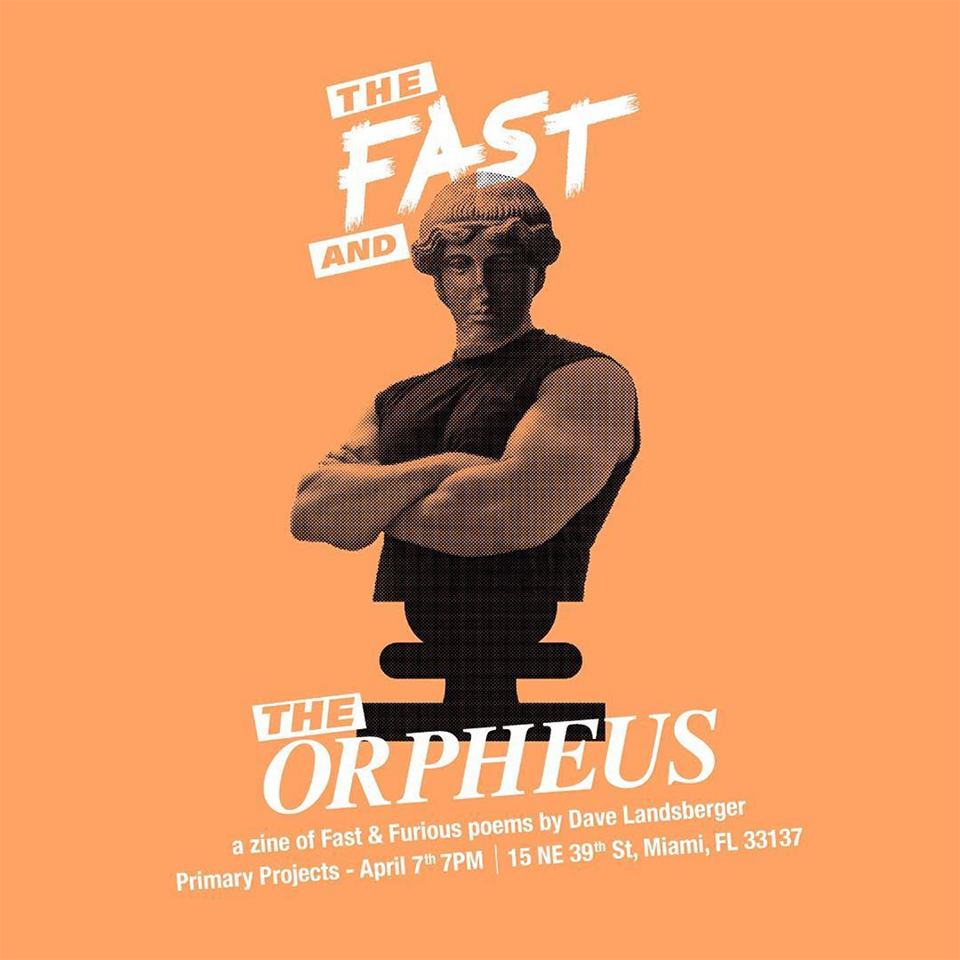
O, Miami + Dave Landsberger at Primary.

April 04, 2017

Poet Dave Landsberger culminates his day shooting a poetry-themed remake of 2 Fast 2 Furious with a reading and party at Primary Projects in the Design District.

Landsberger and guests read poems commemorating the death of Paul Walker and other tributes to the Fast Franchise inside of a white Ferrari, generously donated by Lou La Vie, Miami’s Premier Exotic Car Rental Agency.

Get a limited edition “2 Poetry 2 Ferrari” zine with the purchase a special ticket, or get a copy the night of (assuming supplies last) by purchasing Landsberger’s debut collection, Suicide by Jaguar.

After the reading, TURN ON THE AFTER-PARTY-BURNERS with ice cold “NosTails” and an original “Fast” playlist dominated by Ja Rule & Ludaaaaaaaaa.

Sponsored by Lou La Vie, Miami’s Premier Exotic Car Rental Agency

BLOG_IMAGES_NEW_SITE_NOISY.jpg

Noisy on Snakehole

March 23, 2017

Words by Tim Scott

Though I’ve not experienced Churchill’s Pub, I’ve heard a lot about the Florida music institution located in Miami’s Little Havana. Since 1979, the bar and venue, that many call the CBGB of the south, has hosted some wild musical acts and some wilder times. Autumn Casey and KC Toimil have spent many late nights at the bar as employees, customers and bandmates. Their band Snakehole, has played Churchill’s countless times and the place’s noisey din of the place seeps into their new album Interludes of Insanity.

Recorded by Ben Greenberg (Uniform, Mission Bubble) in Hudson, New York’s Waterfront Studios, the album has Autumn and KC plugging into some hefty noise that leans on feedback but also melody. This is a noise punk power trip that is remarkably listenable.

Piano compositions that peaked through on their self-titled 12″ are given more light on “Interlude Pt. 1” and a strange, almost eerie tone floats between the cracking and loud experimentation.

Take a listen below and read a conversation we had with KC and Autumn.

Noisey: How much does your sound owe to the humidity and closeness of a Miami July?

It’s not quantifiable but it’s definitely present. A swamp vibe does seep in every now and then, and we’ve written songs inspired by our proximity to tropical insects. The song “Izardus” was written in KC’s backyard while lizard watching.

Do you spend much time in the Florida Keys?

As much as we can! We recorded a music video down there at KC’s family’s house, where Satan comes to corrupt us in a wholesome environment. KC had a couple secret shows down there, where only a handful of people would be invited. We also love to just go down there and chill and go to the Caribbean Club.

The band is now split between Miami and Philly. Why is that?

Autumn fell in love and had to relocate. KC is still holding it down in Miami. We are both independent forces and make it work when we come together, and we have been able to visit pretty often. And we hope that having dual bases will present us with more opportunities.

Your sound has changed over time too right?

Yeah, in an ironic twist, the more we learned to play and get comfortable with our instruments and each other, the less cohesive and more wild we became. We also started off touring with Rat Bastard and we would always play noise/experimental shows, and that for sure influenced us to experiment more ourselves.

What is your craziest Churchill’s experience?

We’ve both have been hit in the face by flying shrapnel. KC got hit by a chair during a Cock ESP set, Autumn got hit right between the eyes by (I don’t even know what that was) during a Laundry Room Squelchers set.

One night, towards the end of the original owners tenure, was especially nuts. Autumn was bartending and a full on riot ensued. People were tearing at the walls as if the Titanic was going down and Churchill’s paraphernalia were the life preservers. Over the years we’ve seen our fair share of nudity, fires, rats, possums, explicit drug use, motorcycles in the building, bodily fluids.. etc. We should write a book.

I like the track “Good Conversation”. What makes for a good conversationalist?

Thanks! This was actually the first song we wrote for the album. It’s about social media, and sometimes because of it the lack of good conversation. The lyrics basically talk about being connected in fear and vanity to a network of people and questioning whether or not you have a pulse. It’s also about the good musical conversation we love to share with each other. So maybe to be a good conversationalist you should pick up an instrument.

LINK | on NOISY

ORDER Interludes of Insanity here - wharfcatrecords.com/store/pre-order…des-of-insanity ORDER on Bandcamp here - wharfcatrecords.bandcamp.com/album/pre-…f-insanity ORDER on Apple Music - https://itunes.apple.com/us/album/interludes-of-insanity/id1199342901 Snakehole has returned, and on the Miami/Philadelphia noise rock duo’s new LP, Interludes of Insanity, KC Toimil and Autumn Casey up the clarity, volume, crunch, and sophistication in a major way. Recorded by the prolific and precise Ben Greenberg (Uniform, Mission Hubble) in Hudson, New York’s cavernous Waterfront Studios, Interludes of Insanity showcases the duo’s headway into layering and experimentation. The LP makes no qualms; it’s the main act, and it wedges itself firmly into the tradition of cohesive, almost narrative, albums. Autumn and KC reiterate that the LP is a continuation of their self-titled 12”, and though there are similarities, Interludes of Insanity feels more realized, demonstrating a band fully in control of its sound and ethos. Fans of the 12” will find more snarling, filth-drenched grime rock, but, as that record hinted at, Snakehole here wields beauty just as easily as darkness. The piano sections that would peek their heads out of the woodwork sporadically on the 12” have become more full, more central. But there’s unease in the beauty, too — a little bit of reality. The album stands as a testament to self-actualization, and it’s as clear as it is engaging. But that’s what happens when your music isn’t confined to permutations on one song, isn’t it? Stereogum two minutes of rapid-fire guitar sludge and drum battery, topped off with willfully abrasive vocals that hit like a rallying cry in the midst of a warzone — so, basically it’s the sound of political discourse circa now, only much more viscerally satisfying” Premiere of “Bum Song” – “ Noisey - "aggressive and genre-leaping rock music" CLRVYNT - "two ferocious women dead-set on stirring up chaos" Post-Trash - "a crushing and unwieldy sprawl of blistering feedback, dense riffs, and immersive vocal melodies"
Snakehole-at-Churchills-by-Kelly-Breez-2.jpg

CLRVYNT on Snakehole

March 23, 2017

Words by Jordan Reyes

“Good Conversation” is the culmination of everything that Snakehole do best. The Miami / Philadelphia noise-rock duo — comprised of singer-drummer KC Toimil and singer-guitarist Autumn Casey — makes abrasive music, and “Good Conversation” is one of the duo’s meaner songs. Though it’s a familiar, memorable track to anyone who’s seen the band live in the last few years, it sounds even bigger recorded, thanks in part to Ben Greenberg’s studio wizardry.

The song begins with Casey’s swamp metal riff before being joined by Toimil’s pummeling rhythm. It proceeds in a slow build towards wonderful cacophony, all the while keeping a firm beat on the duo’s signature, maddening, noisy miasma. “Good Conversations” is almost a microcosmic effigy to new LP Interludes of Insanity as a whole. It’s got a great riff, a shit-ton of anger and controlled chaos — in short, everything you’d want from a Snakehole tune, except it sounds fucking massive this go-round.

Interludes of Insanity is out March 23 on Wharf Cat Records.

LINK | on CLRVYNT

TYPOE_TOYSBOYS.jpg

Toys for Boys Magazine on TYPOE

March 17, 2017

Meet Miami’s finest master, a true Contemporary genius, whose experiential and interactive works are subsequently hanging on the walls and gracing the collections of some of the world’s most influential art collectors.

At fifteen years old, Michael Andrew Gran was not the typical Miami boy. He had major aspirations and dreams. Most kids of that age look forward to a crazy party life, mixed with a great college education followed by a future of a 9 to 5. However, Michael, who is known as TYPOE among the vast international community of fashion designers, artists and collectors, well, he was a gentleman whom had his very own vision.

In becoming the hugely successful artist that he is today, TYPOE’s approach to conquering the contemporary art market was not that of the average master of this generation. He believed in teaching himself through self-education, sharing “I really wanted to learn the world. I did not believe in going to school and paying someone to show me the way people did it. So, I dove face first into my personal and extensive collection of art books,” and the rest is history.

– – – – – – – – – – – – – – – – – – – – – – –

Meet TYPOE, the critically acclaimed thirty-three year old, with a story to be desired, and a man with dreams that have not only become his reality, but surpassed all of his, and our, expectations.

TFB: TYPOE, tell me about how this all began. Where did you study and learn the tools to become the artist that you are today?

Typoe: I didn’t go to college I felt like if I went to college, I would be doing a safety job. I was always infatuated with the old masters’ ways of doing things. I had a fascination with a Belgian artist named Jan Van Eyck from the 1390’s. I had also decided that I really wanted to learn the world through experiencing it. I did not believe in going to school and paying someone to show me the way people did it. I went and bought the old books, and I have an art library. A local artist Tao Rey taught me early on not to reinvent the wheel nor recreate the same sort of works as everyone else.

TFB: So, has creating art been your only job in life? When you were young was it all that you wanted to do?

Typoe: No, it is actually funny. Growing up in Miami, I worked in various jobs, like in construction. I also worked at Don Pan, and even at Parrot Jungle for one day, but I quit. I sold furniture for two years at West Elm. I also volunteered with DFYIT, a drug-free youth program in town, and mentored middle school kids on how to paint murals. I explained how important it is to be an artist without getting fucked up. 

TFB: How beautiful that you give back to the local community! Tell us about your sobriety.

Typoe: I have been Sober for thirteen years. To me, helping kids, helps me with my sobriety. When I got sober at the age of twenty, that was when I got serious with my work. I realized I had purpose, and the meaning of life had become so different

TFB: And have you always lived in Miami?

Typoe: Miami was a different world. I nearly moved to New York City, but I ended up staying because I love Miami SO much.

TFB: So considering you are a local of the Magic City, what galleries here represent your work, and speaking of your work, aside from art, tell us about the TYPOE collaborations.

Typoe: I am a free agent, so I have no representation. It has been so amazing, I have been commissioned by private clients to art dealers from different cities, so I am just working on constantly creating.

Regarding my collaborative projects in fashion, they were all unique and I loved every single project. I love what I did with Del Toro, where I designed a dress shoe with him in 2014 and that led me to a few projects that are in the works. Getting into fashion and having brands interested, is what keeps me going. Oh, and fresh off the press, I think you must know that I have a sneaker coming out in the near future with Haitian designer Fabrice Tardieu.

TFB: TYPOE, over the past years, you have been doing many projects with the hottest family in the hospitality world, the Alan and Ximena Faena. You first worked together in Miami than in Argentina and most recently at the Faena Art Center during Art Basel. Tell us ALL about it!

Typoe: The first project I did with the Faena’s, was at their property called Casa Claridge on Miami Beach. I took the opportunity to recreate the stuffy elevator experience by outfitting the entire space in iron, so it was magnetic and so, I covered it with magnets. I believe in engagement and playful experiences. As people played, they would leave messages, and future people who would enter, would see it.

After the elevator project, they asked me if I wanted to do a solo show in Buenos Aires. I was like ‘why are you even asking me, you know its yes?!’ (he hysterically laughs). When I saw the space I knew what would go in there.

TFB: OH WOW! A solo show. Superb! How long did the project take to execute?

Typoe: The whole project took five months, and I fully understand what the term ‘it takes a village,’ means.

It was a really awesome experience. I had met the right people, and everything fell into place. The platform they gave me made me feel majorly accomplished. I finally got to execute my work on a scale that I had dreamt of, and until you can actually create your works on a massive scale that they afforded me, you just never understand it.

My show in Argentina had a huge purpose, which was to respond to the world. Currently, it is off. A big problem is how we learn and retain info. As children, we learn, a lot of information. Some are right, and some are wrong, hence my building blocks. The whole point is learning how to play with space, interact with others, create and live. Many people get lost early on and take too much or don’t work together. Not to be an asshole, but people can be fucked up, and it is the parents’ responsibility. Like, if your parents are racist, you may be too, and especially in the times we are living in today, it is SO important for us to educate. I created an adventure for adults, so people can go on a journey of self-discovery and reflect and respond to their world. How do they choose to build it?

My exhibit also consisted of Ravens and tombstones, hourglasses, to reference life, time and death, referring to ‘what the fuck am I doing with my life.’ It was the first time that I have gotten any sort of political view out. My work had been more personal. It is my voice and what I have to offer.

TFB: So, back to Miami, tell me about your Art Basel project.

Typoe: The Faena’s asked me to design a functional space at the Faena Bazaar. I had never created a space that was catered around eight brands, and so that was a whole new experience. It was all around fascinating because, by nature, I am a collaborator. This is why I like working with brands, teams, people, other than myself.

TFB: So what is happening now?

Typoe: I am here in my studio is in little Haiti and I just renovated my new house, so I am in the nesting phase with my rescue pup Emma, who is the best assistant ever!

I am currently working on a few new things, including a new series and some commissions. I am also just creating works, in the form of sculpture, light boxes, text, and it is all exploratory, not for a show but for myself.

TFB: And last but not least, explain a bit about your role in Primary Projects.

Typoe: Primary Projects, a gallery owned by a group including Cristina Gonzalez, Books Bischof, and myself. I am a partner, and work mostly with the artists and on shows, but we all work on it together. Our paths cross between creative, business and vision. Right now we are working with Kelly Breez, a female artist who is local and her show opens this month. She has a show at Locust Projects, that is also opening at the same time as ours. It is across the street and we will all work together as a community.

Autumn_KellyBreez1.jpg

ALT ESC on Autumn Casey

March 17, 2017

Words by Sara Blazej

Autumn Casey is a visual artist and musician whose oscillating practice moves between collage, sculpture, and video. Her physical works consist of found items laden with cultural and personal significance that are assembled into poetic groupings from which associative meanings emerge. In placing the precious and the pedestrian into conversation with each other and the viewer, she subverts her own economy of materials and question notions of subjective object literacy.
One of the few artists I’ve known from Miami to dig in and set up shop in the city of tropical transience, C

asey has developed a successful creative practice, most recently evidenced by her solo show Balancing Infinity at Primary Projects, which closed last month. Since graduating from New World School of the Arts in 2011, she has been influential in shaping Miami’s underground art and music scene, notably leading one of BFI’s infamous Weird Miami bus tours, which located sites of wealth disparity and highlighted artistic uses of spaces in decay. Casey has exhibited at MoCA North Miami and The Perez Art Museum (PAMM), among other institutions in Miami, New York and Philadelphia. Running alongside her art practice is her band Snakehole, which launches its new record on March 31 at Silent Barn in Brooklyn. We met up for coffee in the Lower East Side to discuss her process, practice, and finding the balance in it all.

Why do you choose to mainly work with sculpture and collage?

A lot of times I find that my work is very reactionary. Depending upon situations, given materials, and often self-imposed limitations, I tend to carve something out from what’s available, which in a way is a self-portrait. I think I like to work with sculpture and collage because they both allow me to combine disparate objects, time periods, feelings, and memories to form something succinct that allows me to reflect something extremely personal, and at the same time offer it up in a more democratic or universal playing field. By using what’s available to many, I display my subjectivities through the selection and combination process.

Do you ever incorporate your dance background into your practice, or make any other performance work?

I’ve done a few performances in the past. I screamed really loud at all the (Miami) art fairs one year. That piece was called Cicada, named after the magical bug that comes up from the earth and screams. I felt that was a pretty fitting metaphor for Art Basel – it’s once a year, when all these things and people are coming to the surface to scream and get attention. Also it’s kind of about being an artist and feeling the pressure like you need to do something. So I was like, “What if I literally just screamed?” I did it a few times: I did it at the Vernissage, I did it at Art Miami and I did it at NADA. I just screamed really loud and then made a quick exit.

Were there any incidents with security?

At Art Miami I got asked to leave. And I had people asking if I was okay. Everyone’s reactions were so different: some people would be scared, some people would clap afterwards, and some people would laugh. And then it was like, “Back to the next thing.”

“Back to business.”

Yea. And in regard to incorporating dance into the work, I do get really physical sometimes. With my sculptures, a lot of it is about balance. It’s trying to make weird things actually balance. Sometimes I’m squatting, sometimes I’m hunched over for a while just balancing the thing.

So, in balancing objects in your studio, you’ve noticed a vocabulary of postures emerge that recall your dance training, like holding various ballet poses for long amounts of time. Sounds like a very elegant endurance performance. Have you ever recorded yourself working?

I took some pictures once. I’ve also filmed myself in a video when I was getting rid of all my shoes. Sometimes I feel like after I do something, I need to go do the opposite of what I just did, to not ever conform into like one thing. My last show, Balancing Infinity didn’t have any videos, and now lately I’ve been working on a lot of music videos.

For your own music?

I have in the past, but right now I’m doing one for Nick Klein. It’s a track for that L.I.E.S. comp. It’s pretty fun to make a techno music video. There’s so many beats, so many chances to click the blade button, you know?

Totally. How did you come to direct a Snoop Dogg / Boys Noize music video a few years ago?

The gallery I work with, Primary, are friends with some of the people involved in Boys Noize’s management troupe. They told me that Boys Noize and Snoop Dogg would be in Miami and they were looking for someone to do a music video. It just so happened that Alex (Ridha, of Boys Noize) was looking for something more artistic and with a gritty underground vibe, so I kind of fit what he was looking for. It was a dream come true. I built the set, directed, filmed with my iPhone, and edited the video. It was so much fun.

How do you balance your own band, Snakehole, with your art practice?

That’s an interesting balance because Snakehole is very cathartic – well, art’s cathartic too, but the band is very cathartic in a way where I’m physically screaming – sometimes even to tears. It’s where this rage gets to come out and it’s very unbridled, whereas my art is a lot more delicate and composed and balanced. It’s kind of like a ying yang.

How do you source the materials for your sculptures?

I usually just go for things that I’m instinctively attracted to. And then it lives with me and hibernates with me until I can figure out how I want to interact with it or how I’m going to make it come to life.

Once you live with this collection of things, what informs the process of putting them together? Is this also mostly instinctual or is it based in formal composition?

It’s a little bit of both. Sometimes it can happen really fast, like I’ll bring something home and immediately know it belongs with this other thing I’ve been saving for a while. Or I’ll see something and I can automatically see what I want it to do. It’s an ebb and flow of these interactions.

How did you apply this intuitive process to your show Balancing Infinity, in which the pieces are based on specific tarot cards? Did you have to adapt to accommodate the “prompt” of the card? 

Well, I would let them make themselves and then I would figure out which card it was. For instance, I didn’t set out to make the Chariot. Me friend was like, “I found these two horses on the road and I thought this would be good for you, for the Chariot.” So I painted one white, and in that way it was kind ofguided in that direction.

I love what you did with The Hermit. 

I like that one a lot. The Hermit was kind of an accident. I bought that clown just to cut off his arms. I wanted his arms. But he just had such a funny posture so I just painted him black and put him in the corner. The Hermit is about being alone with this little light that’s yours and you’re just mesmerized by it.

How did you receive your first tarot deck?

I got it at a Christmas party. We were doing Yankee Swap, and I picked a gift and no one tried to steal it from me. Then the guy who brought it to the party came up to me afterward saying, “It’s weird, I kind of had you in mind when I brought this gift.” So that was weird. I would diddle around with them a little at first and then my relationship with them grew.

Were you interested in any kind of esoteric tradition before that?

My grandmother grew up in show business and she would say, “All we did was talk about astrology” – in show business. So growing up with her, wherever we went she would ask someone their birthday – the whole thing. We didn’t go to church, we were really raised with astrology. Like my mom’s version of our church was watching Touched by an Angel on Sundays. But that’s the closest I would get to esoteric traditions. The cards would reference certain astrological signs, so it was like a gateway.

So what are your sun moon and rising signs?

Pisces sun, Cancer moon, Libra Rising, Venus is in Aquarius

That’s a very gentle triangulation.

My friend Tatiana, who’s a psychic, says I have a trine in water. Apparently, if you have a trine in something it means you’ve mastered that sign. It make sense that mine would be in water because that’s like emotions and I’m very sensitive to emotional vibrations.

Do you know a lot of psychics?

I just know this one lady. I went to Honduras with her back when the world was going to end in 2012. I was working at Churchill’s and she came in and could tell I was fucking over it and she was like “You should come to Honduras with me for winter solstice.” And I was like, “Okay. I will.” And so I quit my job and went to Copán and we watched the sun rise on the top of a pyramid. It was good.

Did anything magical happen?

I swear I saw something…it was a little glimmer in the sky.

What was it?

I don’t know, apparently it’s the center if the Milky Way! She was like, “If we watch the sunrise on December 21st, the planets will be aligned and you’d be able to see the center of the Milky Way.”

Whoa, and you did.

I saw the glimmer.

You saw the glimmer. You mentioned that working with collage and sculpture allows you to combine time periods, feelings and memories – kind of commemorative in a way. Is articulating those memories to the world – by making them physical or visible – a way of immortalizing them?

That’s how I describe that video I made of my nana, and it was like “this would be to immortalize her.” And it was something that was so personal, and yet I’m sharing it with people, you know, it’s also about just trying to be honest with myself.

That video was so beautiful. I still think about it, two years later. I saw it was just acquired by the Perez Museum – congratulations on that.

Thank you, it was pretty wild. To make that video was to immortalize her memory, and now that she’s in the permanent collection of the PAMM, it really takes it one step further, to this extra place. Now my nana will live forever in a lot of people’s memories.

What is it like for you to practice art in the current political climate? Especially making work that’s so tethered to emotionality and lived experience, have you drawn inspiration from it? Has it presented any challenges?

It’s hard for the nightmare that is the current political climate to NOT seep in. I have noticed that things have taken a more sinister, darker turn, however subtle they might be. Lately, at times, it seems harder to engage with my art practice because it’s easy to start to feel helpless when everything seems like it’s going to shit and it feels miniscule compared to all that’s going on. But then you realize you just feel crazier by not engaging in your art practice. Like its the only thing that can start to keep you sane. And then from there hope to make something meaningful that can reflect and speak to the current situation, and create community around it as well. The anger that I feel comes out in a more visceral and direct way when I play music, and from that- it’s definitely a source of inspiration, something to react fiercely against.

LINK | on ALT ESC

IMG_2915.jpg

Autumn Casey at LA Art Book Fair

February 21, 2017

AUTUMN CASEY will have three new works in the form of beach towels available at the PRIMITIVE LANGUAGES table in the Zine section of the LA ART BOOK FAIR. The works are pulled from her latest body of work “Balancing Infinity, While Hanging Upside Down. Watching Lovers Fall from Grace Underneath the Ground.” Each piece comes complete with your very own box of Star Crunch. Delicious in every way.

LA_BOOKFAIR_splash_image-01-1.jpg
Autumn-Install-8_Web_W.jpg

Vice on Autumn Casey

December 07, 2016

Words by Monica Uszerowicz

The experience of entering a three-dimensional tarot deck is akin to viewing Autumn Casey’s solo exhibition at Primary Projects, both in its meditative quality and the title alone, Balancing Infinity, While Hanging Upside Down. Watching Lovers Fall from Grace, Underneath the Ground. There’s a piece that refers to the show’s name, too: a Ferris wheel cart strung upside down with stuffed gloves and Mickey Mouse hands dangling, their arms once blithely in the air. Below are two bears in a state of tantric ecstasy: a plush blue Care Bear’s face is straddled by a pink bear-shaped candle, that’s quite literally melted into its partner. One might infer from them the tarot’s Major Arcana, the Lovers. The Ferris wheel cart is the Hanged Man: the ultimate symbol of transformation, even rebirth.

The show’s name comes from a poem Casey wrote after a three-card reading, which became a daily ritual. She’d pulled the Lovers, reversed, along with the Two of Pentacles and the Hanged Man. “I asked the cards, ‘How do I describe you?’” she explains to The Creators Project. “I felt like I was the Hanged Man—and when I was able to create again, it was like an explosion. Sometimes people think spiritual growth happens in very serious moments, so this is about that reconciliation—and just like the tarot cards, there’s an underlying subtle darkness. There is positive and negative. It is always about balance.”

The language of the tarot is first about the initiations of life—the way we move through it, transforming—and then about balance: the alchemical space between two ideologies. Casey’s art practice is like that, too, her sculptures often massive but hanging precariously, her video work tenderly exploring history and memory. Balancing Infinityfeatures a series of sculptures and 78 collages—functioning, effectively, as a tarot deck of their own—all inspired by the Rider-Waite deck.

The collages, constructed over the last three and a half years, contain, as Casey describes, “everything from old art history books […] to illustrated Shakespeare plays.” Like the unfolding of a reading, the first set of collages seemed to make themselves. “I would pull images and then infer which card it was, seeing which archetypes drove the collage,” she says. Casey’s Hermit card features a woman lighting her way through darkness, a man spinning a gradient of bright stripes, and a sleeping figure; her Three of Swords—depicted in the Rider-Waite as a heart pierced by three blades—has a bemused Charlie Brown, Snoopy atop his head. Sometimes, the pain inferred by the Three of Swords is confusing.

“The same idea fell over into the sculptures; I let them build themselves,” Casey explains. While the collages line two walls, the sculptures are spread out, creating an indoor garden of strange, delicately assembled symbols and found objects—pieces of Casey’s childhood, toys and treasures and furniture. The Fool sculpture is a frolicking wire man, clothed in a shirt sewn by Casey’s grandmother for Alice in Wonderland’s white rabbit. Judgment, Light as a Feather, a reference to the card and the Egyptian goddess Maat’s weighing of the heart, is a foam cross sprouting tiny yellow flowers, little toy growths.

On a recent visit to the space, Casey gestured to one sculpture, all flower-adorned blue yarn flowing from the curved legs of a table. “Do you want to take a guess as to which this one is?” she asked. “The Empress?” I replied. I was wrong: it was the Queen of Cups. In the Rider-Waite, she stares at her chalice, soft water pooling round her feet. Later, Casey gave her a more humanoid shape, though she’s still lush and sky-colored.

To be clear, Casey’s sculptural references to the tarot are not so specific nor immediately obvious, and her collaged cards have a life of their own. Tarot is often about the strength of the self, and so too is Balancing Infinity. To evoke the cards is really to evoke the archetypes of daily existence, the kind we experience in our own emotional landscapes—when we play the fool or or feel reborn—and, at least in the realm of an art space, we can understand these moments as we’d like. Balancing Infinity, then, is about our own interpretative power. It can mean (almost) whatever you want it to.

Link On | CREATORS PROJECT

Prev / Next

Words.

Weaving spiders come not here.


Featured Posts

Featured
May 21, 2026
Perez Art Museum Miami (PAMM) Acquires Luna Palazzolo-Daboul
May 21, 2026
May 21, 2026
May 11, 2026
Art Burst on Wade Tullier
May 11, 2026
May 11, 2026
April 29, 2026
Piero Penizzotto at MoMA PS1
April 29, 2026
April 29, 2026
April 18, 2026
Impulse on Typoe Gran at BOCA Museum
April 18, 2026
April 18, 2026
February 10, 2026
Piero Penizzotto at MoMA PS1
February 10, 2026
February 10, 2026
January 15, 2026
that which frightens us - a look into the artists
January 15, 2026
January 15, 2026
August 25, 2025
Philip Smith on Magnetic Fields at MOCA North Miami
August 25, 2025
August 25, 2025
August 23, 2025
Adam Curtis - HyperNormalisation
August 23, 2025
August 23, 2025
May 18, 2025
Terence Riley on Charlie Rose
May 18, 2025
May 18, 2025
March 3, 2025
Typoe Gran & Allison Glenn | We should talk. - No. 001
March 3, 2025
March 3, 2025
February 17, 2025
We should talk.
February 17, 2025
February 17, 2025
October 15, 2024
Dustin Emory & Kathryn Kampovsky - VIDEO
October 15, 2024
October 15, 2024
September 30, 2023
Modern Luxury on Primary.
September 30, 2023
September 30, 2023
June 9, 2023
Wade Tullier in Clay Pop from Rizzoli
June 9, 2023
June 9, 2023
May 30, 2023
Artburst on Avery Pack
May 30, 2023
May 30, 2023
Primary Projects Logo
Instagram Email

7410 NW Miami Court
Miami FL, 33150
1.954.296.1675

Visiting Hours :
Thursday & Friday : 11 - 6 PM
Saturday : Noon - 4 PM
Sunday - Wednesday : by appointment

Sign Up For Our Mailing List

We respect your privacy.

Thank you!